Stoichiometry
Stoichiometry describes whether the elements of a compound are present in the integer ratio given by its chemical formula, such as 3 to 4 in silicon nitride (Si₃N₄), 1 to 2 in silicon dioxide (SiO₂) and 1 to 1 in gallium arsenide (GaAs). A film that deviates is called non-stoichiometric and is written as SiOx or SiNx.
Also called: stoichiometric composition, non-stoichiometry
Diagram
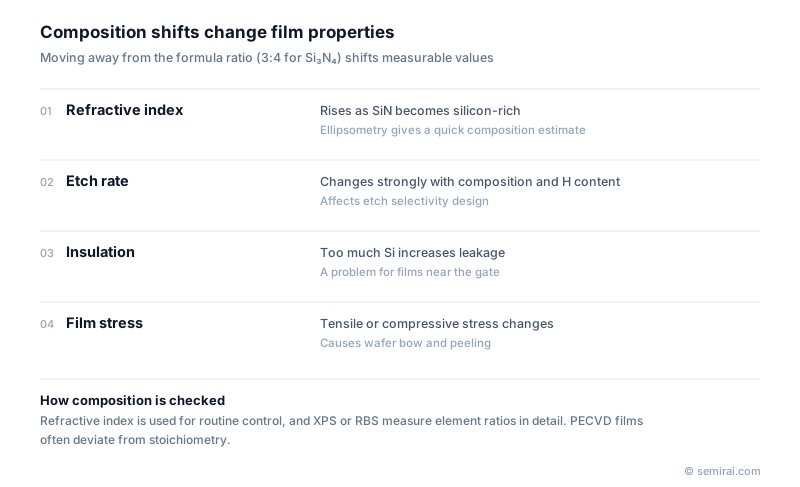
Why thin films drift from stoichiometry
Composition depends on how a film is made. Silicon nitride from high-temperature low-pressure CVD (LPCVD) is close to stoichiometric Si₃N₄, with a refractive index of about 2.0. Nitride from low-temperature plasma-enhanced CVD contains a lot of hydrogen and its silicon-to-nitrogen ratio is shifted.
Deviations are sometimes intentional. Silicon-rich nitride is used to lower film stress or to store charge, as in charge-trap memory layers. Whether intended or not, composition changes the refractive index, etch rate, insulating properties and stress of a film, so it has to be measured and controlled.
Stoichiometry in high-k and compound semiconductors
In high-k gate dielectrics such as HfO₂, regions short of oxygen, called oxygen vacancies, trap charge, raise leakage and make the threshold voltage drift, so oxygen content is tightly controlled. In compound semiconductors such as GaAs and SiC, a small deviation in the element ratio during crystal growth increases point defects and changes electrical behaviour.
Some devices exploit non-stoichiometry deliberately. Resistive RAM (ReRAM) switches by moving oxygen vacancies in a metal oxide to form and break conductive paths.
Japanese companies involved
- HORIBA makes spectroscopic ellipsometers and other analytical instruments that are used to measure film thickness and optical constants, from which composition can be inferred.
- HORIBA · Mass flow controllers and process monitoring instruments
- Tokyo Electron (TEL) · Coat/develop, etch and deposition equipment
FAQ
How is the composition of silicon nitride checked?
The quickest check is the refractive index, measured by ellipsometry: stoichiometric Si₃N₄ is about 2.0 and the index rises as the film becomes silicon-rich. For direct element ratios, X-ray photoelectron spectroscopy (XPS) or Rutherford backscattering spectrometry (RBS) is used.
What does the word stoichiometry originally mean?
In chemistry it is the field that deals with the quantitative relationships between substances in a reaction. In materials and thin-film work, the word is mostly used for whether a compound's composition matches its formula.
Related pages
Sources
Last updated: November 2, 2026