RF Test (S-parameters)
RF testing measures the performance of semiconductors that handle radio-frequency signals, from hundreds of megahertz to tens of gigahertz, as used in smartphones, wireless LAN and radar. Instead of checking 0s and 1s, it measures analogue behaviour: how much a device amplifies a signal, how much noise it adds and how much it distorts the waveform.
Also called: radio-frequency test, high-frequency test
Diagram
What is measured
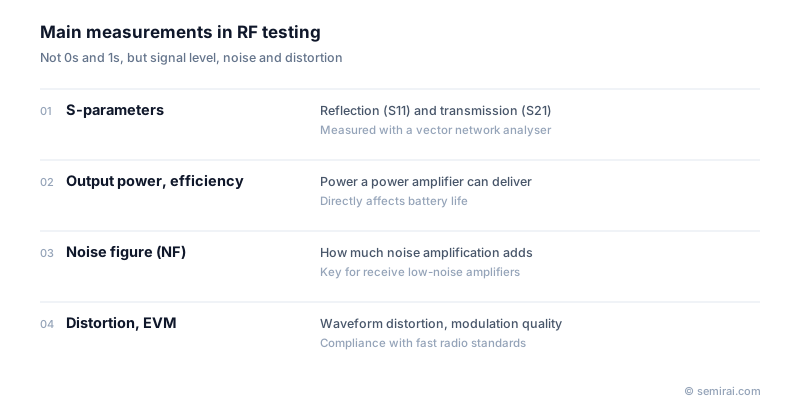
The basic measurement is the set of S-parameters (scattering parameters). A high-frequency signal is applied to the device input, and the amplitude and phase of the signal reflected back at the input (S11) and of the signal transmitted to the output (S21) are measured across frequency. A vector network analyser (VNA) is the instrument used.
Other measurements include output power and efficiency of power amplifiers, noise figure (NF) of low-noise amplifiers, distortion, and error vector magnitude (EVM), which shows how accurately a modulated signal is reproduced. The set of tests depends on whether the device is an amplifier, switch, filter or full transceiver.
RF testing in production
Volume testing uses RF testers, which build these instruments into ATE, together with handlers that feed packaged parts one after another. At high frequencies even short traces and parasitic elements in the test socket and DUT board change the result, so calibration that removes errors up to the measurement reference plane at the device terminals is essential.
As frequencies rise, as with 5G millimetre-wave bands, devices with integrated antennas are also tested over the air (OTA), by radiating and receiving signals in free space inside a shielded chamber.
Japanese companies involved
- Advantest offers RF measurement options for its SoC test systems, used to test wireless transceivers and RF front-end parts in volume production.
- Advantest · Automated test equipment (ATE) for SoC and memory
FAQ
What are S-parameters?
They are ratios that describe how a device responds to a high-frequency signal: how much of the input is reflected back (S11), how much passes through to the output (S21), and the reverse-direction equivalents (S22, S12). Each is a complex value with magnitude and phase, measured over frequency, from which gain, loss and matching are derived.
Why is calibration so important in RF testing?
At gigahertz frequencies, cables, sockets and board traces change amplitude and phase noticeably. Calibration measures known standards, such as short, open, load and through, to calculate these errors and remove them, so that the reported values describe the device rather than the fixture.
Related pages
Sources
Last updated: November 13, 2026