Kelvin Connection (Four-terminal Sensing)
A Kelvin connection, or four-terminal sensing, attaches two separate pairs of wires to the object being measured: force lines that carry the current and sense lines that measure the voltage. It removes the voltage drop across leads and contacts, so very small resistances can be measured accurately. It is named after Lord Kelvin.
Also called: four-wire measurement, 4-terminal sensing, Kelvin sensing
Diagram
Why two wires are not enough
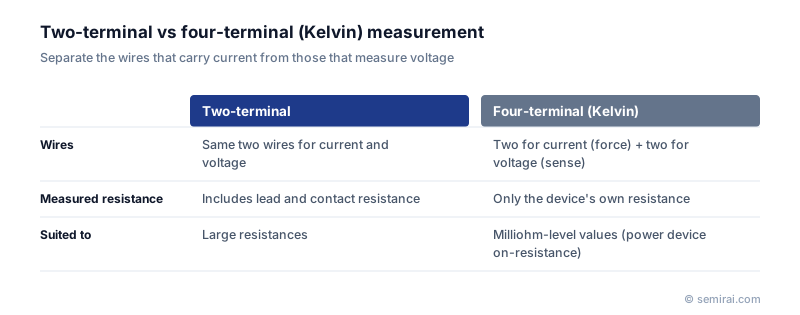
With a two-terminal measurement, the same two wires carry the current and measure the voltage, so the reading includes the resistance of the leads and the contacts. When the target is a few milliohms or less, those parasitic resistances can be larger than the value of interest.
In a Kelvin connection the force lines drive the current, while the sense lines touch the device directly at its terminals. The voltmeter input draws almost no current, so there is practically no drop along the sense lines, and the measured voltage is that of the device alone. The four-point probe used to measure wafer sheet resistance works on the same principle.
Where it is used in semiconductors
Testers use Kelvin connections to measure the on-resistance of power MOSFETs, which may be only a few milliohms, and ATE device power supplies use remote sensing to hold the correct voltage at the device pins rather than at the supply. Kelvin test sockets place two pins, one force and one sense, on each device terminal.
Power device packages also use the idea. A four-pin package adds a dedicated Kelvin source pin used only as the reference for the gate driver. The large switching current then flows through the main source pin, and the voltage induced by its parasitic inductance no longer subtracts from the gate drive. This allows faster switching and lower losses, which matters for SiC MOSFETs.
Japanese companies involved
- Toshiba Electronic Devices & Storage offers power MOSFETs in four-pin packages with a separate Kelvin source terminal for the gate driver.
- Advantest's test systems use force and sense connections in their device power supplies and precision measurement units.
- Toshiba Electronic Devices & Storage · Power MOSFETs, IGBTs and discrete semiconductors
- Advantest · Automated test equipment (ATE) for SoC and memory
FAQ
Why does a Kelvin connection give a more accurate reading?
Because the wires that carry current are separated from the wires that measure voltage. The current-induced drops in leads and contacts stay outside the voltage measurement, and since almost no current flows in the sense lines, their own resistance does not matter either.
Do Kelvin sockets need four contacts per pin?
They need two contacts per device terminal: one force and one sense. A two-terminal resistor therefore uses four contacts in total. Because the contacts must land on the same small lead or pad, Kelvin sockets need fine pitch and careful alignment, which raises their cost.
Related pages
Sources
Last updated: November 2, 2026