Ultimate Pressure
Ultimate pressure, or ultimate vacuum, is the lowest pressure a vacuum pump, or a chamber connected to it, settles at after being pumped for a long time with no gas admitted. It appears in pump catalogues as a performance figure and also serves as a check that a chamber is correctly assembled, clean and free of leaks.
Also called: ultimate vacuum, base pressure
Diagram
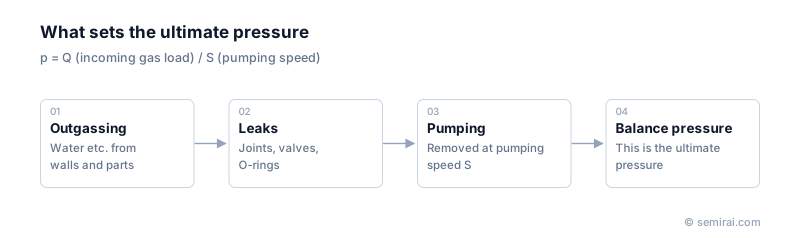
What sets the ultimate pressure
Chamber pressure is a balance between the gas the pump removes and the gas entering the chamber. The incoming gas includes outgassing, such as water released from walls and parts, leaks through joints and valves, and gas flowing back from the pump itself.
Ultimate pressure can be estimated as p = Q/S, where Q is the incoming gas load and S the pumping speed. Reducing outgassing and leaks lowers it more reliably than adding pump capacity.
Getting lower and staying healthy
In high-vacuum systems, water desorbing from the walls usually sets the ultimate pressure. Engineers bake the chamber to drive the water off, polish surfaces to reduce their effective area and choose materials that outgas little.
Logging how long a chamber takes to reach its base pressure, and how fast pressure rises afterwards, is a simple daily check. A change in either figure can reveal O-ring wear or a new leak early, before it affects the process.
Japanese companies involved
- ULVAC and Ebara make vacuum pumps whose catalogues specify ultimate pressure as a key performance figure.
FAQ
What should I suspect if the ultimate pressure will not drop?
First check for leaks, such as damaged or loose O-rings and leaking joints. Next suspect outgassing from walls and parts, especially after venting to air or installing new parts, and then pump degradation. A rate-of-rise test, a helium leak test or a residual gas analyser helps narrow down the cause.
Why is my system's pressure higher than the catalogue's ultimate pressure?
Catalogue figures are measured with the pump inlet blanked off under near-ideal conditions. A real system adds outgassing from chamber walls, limited pipe conductance and small leaks, so its ultimate pressure is normally higher than the pump's catalogue value.
Related pages
Sources
Last updated: November 2, 2026