Ultra-High Vacuum (UHV)
Ultra-high vacuum (UHV) is the range of very low pressure that Japanese Industrial Standards define as 10⁻⁵ Pa and below. Real equipment usually runs at around 10⁻⁷ to 10⁻⁹ Pa. At these pressures a gas molecule travels kilometres, on average, before it collides with another gas molecule.
Also called: UHV
Diagram
Why UHV is needed
The main reason is keeping surfaces clean. At around 10⁻⁴ Pa, a freshly cleaned surface is covered by one layer of residual gas molecules within seconds. At around 10⁻⁸ Pa it stays clean for hours.
That is why UHV is used in molecular beam epitaxy (MBE), which builds crystals one atomic layer at a time, in surface analysis such as X-ray photoelectron spectroscopy (XPS), and in the electron guns of electron microscopes.
How UHV is achieved
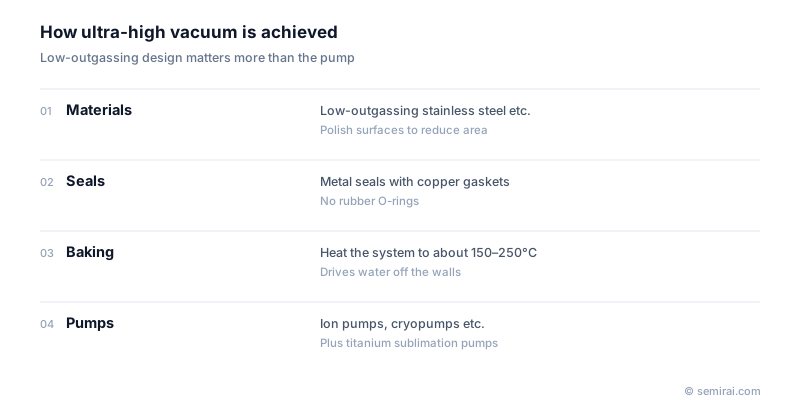
Reaching UHV depends less on pump size than on reducing outgassing from the chamber. Builders use low-outgassing materials such as stainless steel and replace rubber O-rings with ConFlat flanges, in which a knife edge bites into a copper gasket.
After assembly, the whole chamber is baked at roughly 150–250°C to drive out water, and pumping is done with ion pumps, cryopumps and titanium sublimation pumps. Pressures well below the usual UHV range are sometimes called extreme high vacuum (XHV).
Japanese companies involved
- ULVAC makes sputter ion pumps and other equipment for UHV, and ULVAC Cryogenics makes cryopumps.
- ULVAC-PHI makes surface analysis instruments such as XPS systems, which operate under UHV.
- ULVAC Cryogenics · Cryopumps
- ULVAC-PHI · Surface analysis instruments (XPS, TOF-SIMS)
- ULVAC · Vacuum deposition (sputtering) equipment and vacuum pumps
FAQ
Why is UHV needed to keep a surface clean?
Even in vacuum, residual gas molecules keep striking surfaces and sticking to them. At around 10⁻⁴ Pa a clean surface gains a full molecular layer in seconds, while at around 10⁻⁸ Pa this takes hours. Surface analysis and atomic-layer growth need that time window.
Why are rubber O-rings not used in UHV?
Rubber absorbs gas and slowly releases it, and it lets gases such as helium permeate through. Both effects stop the chamber reaching UHV pressures. Metal seals, where a knife edge crushes a copper gasket, are used instead and also survive baking.
Related pages
Sources
Last updated: November 1, 2026