Turbo Molecular Pump (TMP)
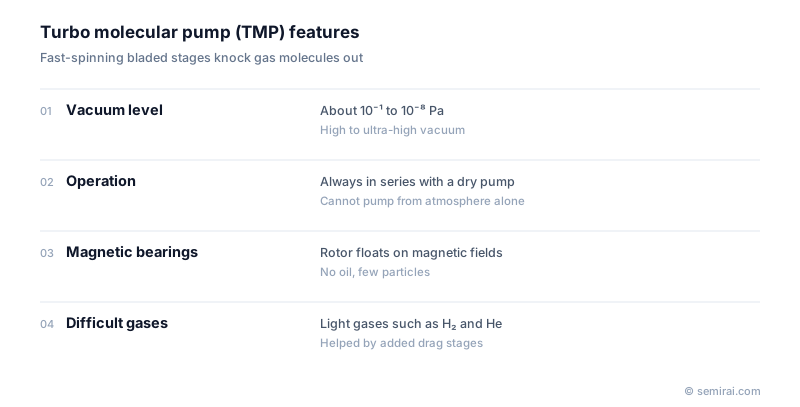
A turbo molecular pump (TMP) is a vacuum pump with many stages of angled blades spinning at tens of thousands of revolutions per minute. The blades knock gas molecules towards the outlet, producing high to ultra-high vacuum of roughly 10⁻¹ to 10⁻⁸ Pa. It always works in series with a backing pump.
Also called: TMP, turbopump
Diagram
How it works
A TMP only works in the molecular flow regime, where molecules hit the walls and blades more often than each other. Each moving blade gives the molecules it strikes a push in the pumping direction, and stationary blades between rotor stages guide them on. The blade tips move at speeds close to the speed of sound.
Because it cannot pump from atmospheric pressure, a dry pump first evacuates the chamber and keeps the TMP's outlet at low pressure. Many TMPs add a Holweck (screw groove drag) stage after the blades. It raises the tolerable outlet pressure and helps with light gases.
Use in semiconductor tools
Most modern TMPs float the rotor on magnetic bearings. With no contact and no lubricant, there is no oil contamination, little vibration and few particles. Light gases such as hydrogen and helium are harder to pump because their molecules move fast compared with the blades, which matters in tools that use helium for wafer cooling.
In process tools, deposits from reactive gases can build up on the blades and unbalance the rotor, and corrosive gases attack parts. Purge gas, coatings and temperature control reduce this. Since the rotor stores a large amount of energy, housings and controls are designed to contain a rotor failure. TMPs are fitted to etch, PVD, ion implant and inspection tools, and pump-down time affects throughput.
Japanese companies involved
- Shimadzu and Ebara make turbo molecular pumps used on semiconductor process and analysis equipment.
- ULVAC makes vacuum pumps and vacuum deposition equipment.
FAQ
Can a turbo molecular pump work on its own?
No. It only pumps in the molecular flow regime and needs its outlet held at low pressure. A dry pump or other backing pump must first rough the chamber down and then run continuously behind the TMP.
Why are magnetic bearings used?
They support a rotor spinning at tens of thousands of rpm without contact. No lubricant is needed, so oil cannot reach the chamber, and there is less wear, vibration and particle generation. This is important for tools with precise stages or strict contamination limits.
Related pages
Sources
Last updated: November 2, 2026