MSL (Moisture Sensitivity Level)
MSL (moisture sensitivity level) is a classification from 1 to 6, defined by IPC/JEDEC standards, of how long a surface-mount component may be exposed to ambient moisture before it is soldered. That exposure time is called floor life: MSL 1 is unlimited, MSL 3 allows 168 hours and MSL 5a only 24 hours, so higher numbers mean stricter handling.
Also called: moisture sensitivity level, floor life
Diagram
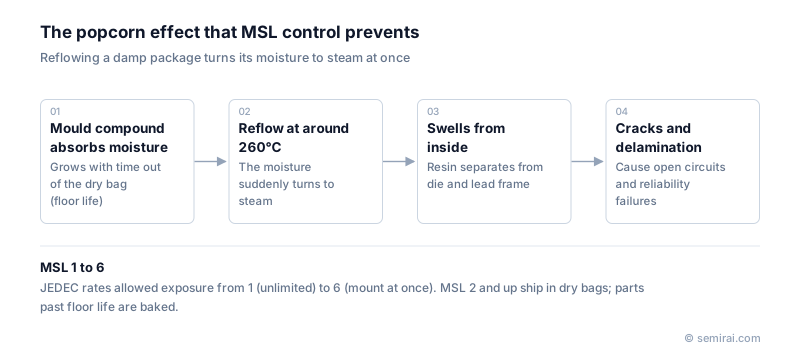
The popcorn effect
Mould compounds absorb water from the air. When a package that has absorbed moisture goes through reflow soldering at around 260°C, the water turns to steam almost instantly and expands. The package swells from the inside, and its layers delaminate or crack. The name comes from the sound and shape of this failure, which resembles popping corn.
Damage is not always visible. Internal delamination between the mould compound and the die or lead frame can remain hidden and lead to broken connections or corrosion later. Lead-free soldering raised reflow temperatures and made moisture control more important.
How the level is determined and managed
To classify a package, samples are soaked at a specified temperature and humidity, passed three times through a reflow profile, and inspected with a scanning acoustic microscope (SAT) for delamination and cracks. If none appear, the package meets that level. Package size, the moisture uptake of the resin and the ratio of die to package area all affect the result.
Parts rated MSL 2 or higher are shipped in moisture barrier bags with desiccant and a humidity indicator card. Once the bag is opened, they must be mounted within their floor life. Parts that exceed it can be baked for hours to days at a specified temperature to drive out the moisture, which resets the floor life.
Japanese companies involved
- Hitachi Power Solutions makes scanning acoustic microscopes, the instruments used to find internal delamination when packages are classified.
- ESPEC supplies temperature and humidity chambers used for the moisture soak step of MSL testing.
- Hitachi Power Solutions · Scanning acoustic microscopes
- ESPEC · Environmental and reliability test chambers
- Namics · Underfill and die attach materials
FAQ
Which standards define MSL?
IPC/JEDEC J-STD-020 defines how packages are classified, and the companion standard J-STD-033 covers handling, packing, drying and floor-life control in the factory.
Why is MSL harder for advanced packages?
Larger and thinner packages warp more and are more affected by absorbed moisture, and stacked structures contain more interfaces that can delaminate. MSL is therefore checked together with HAST and temperature cycling when a new package and encapsulant are qualified.
Related pages
Sources
Last updated: November 2, 2026