HTOL (High Temperature Operating Life)
HTOL (high temperature operating life) is an accelerated life test in which devices are operated continuously at high temperature and at or above their specified voltage to estimate lifetime under normal use. A typical condition is about 125°C for 1,000 hours, and applications that need high reliability, such as automotive, may require longer or hotter tests.
Also called: high temperature operating life test, HTOL test
Diagram
HTOL is not burn-in
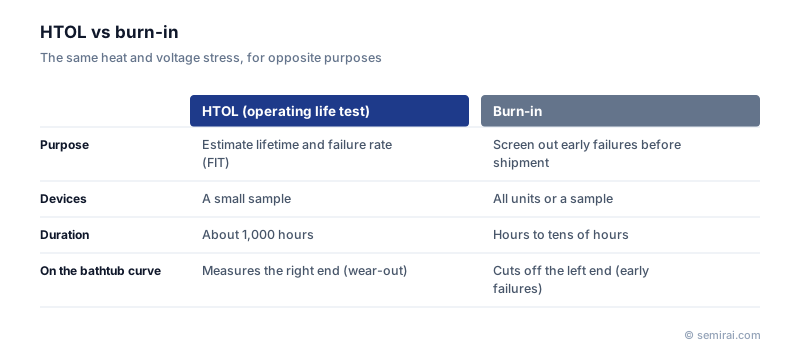
Burn-in and HTOL use similar stress but answer different questions. Burn-in is a screen: production parts are stressed for a few hours so that early failures, the left side of the bathtub curve, are removed before shipment. HTOL is an evaluation: a small sample is stressed for a long time to estimate when wear-out, the right side of the curve, begins.
The output of HTOL is therefore not a pass or fail for individual parts but an estimate of product lifetime and failure rate in FIT (failures per billion device-hours). It is a core test in qualifying a new process or product, and it is repeated when the process changes.
What HTOL accelerates
Raising temperature speeds up chemical and physical degradation exponentially, as described by the Arrhenius equation. Assuming an activation energy for the mechanism gives an acceleration factor, so 1,000 hours at 125°C can be converted into years of use at normal temperature. Raised voltage adds further acceleration.
The mechanisms brought out are mainly front-end wear-out effects: time-dependent dielectric breakdown (TDDB) of gate dielectrics, negative bias temperature instability (NBTI), hot-carrier injection (HCI) and electromigration in interconnects. They appear as threshold-voltage shifts, rising wire resistance or functional failures. Devices are measured before and after the test and must stay within specified limits.
Japanese companies involved
- ESPEC makes temperature chambers and burn-in systems that are used for HTOL and other operating life tests.
- ESPEC · Environmental and reliability test chambers
FAQ
What equipment does HTOL need?
A temperature chamber or oven, burn-in boards that hold the devices and supply power, and pattern generation so the devices are actually operating rather than just biased. Devices are taken out at intermediate points and measured on a tester.
Which standard defines HTOL?
JEDEC JESD22-A108 covers temperature, bias and operating life tests and is the usual reference. Automotive qualification under AEC-Q100 builds on such JEDEC methods with its own sample sizes and conditions.
Comparisons
Related pages
- Burn-In Test
- Bathtub Curve / FIT Rate
- Acceleration Model / Arrhenius Equation
- Time-Dependent Dielectric Breakdown (TDDB)
- Electromigration (EM)
- Temperature Cycle Test (TCT)
- Weibull Distribution
- Arrhenius Plot
- Final test equipment
- Advantest 7038 System-Level Test System
- Advantest T2000
- DISCO DIS100
- Tokyo Electron (TEL) Prexa™ SDP
Sources
Last updated: November 2, 2026