HAST (Highly Accelerated Stress Test)
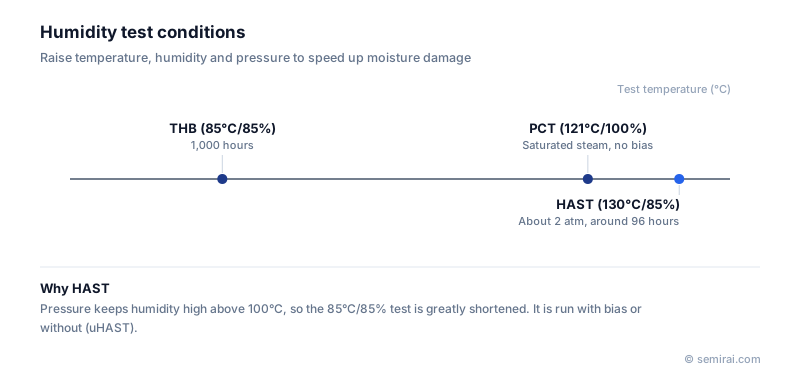
HAST (highly accelerated stress test) evaluates moisture-related degradation of packaged devices quickly by combining high temperature, high humidity and raised pressure. A common condition is 130°C and 85% relative humidity, which takes about 96 hours, compared with 1,000 hours for the traditional 85°C/85%RH test.
Also called: highly accelerated temperature and humidity stress test, biased HAST, unbiased HAST
Diagram
Why the chamber is pressurised
At normal atmospheric pressure, water boils at 100°C, so a humidity test cannot go much above about 85°C while keeping high humidity. Inside a pressure vessel, at roughly two atmospheres, high humidity can be held at 130°C. Moisture then diffuses into the package and reacts much faster, shortening the test by about an order of magnitude.
HAST is a package-level test. It complements temperature cycling, which looks at mechanical stress from mismatched thermal expansion, by looking at the chemical route to failure: moisture and corrosion.
What HAST reveals
Moisture passes through the mould compound and reaches the die and the bonds. There it corrodes aluminium pads, weakens wire bonds and can break thin metal lines. Ionic impurities in the encapsulant dissolve in the water and speed up corrosion, so the purity of packaging materials is part of what HAST evaluates.
HAST comes in two forms. Biased HAST applies a voltage close to real use, so it also brings out electrochemical migration, where metal ions move under the electric field and form short circuits between conductors. Unbiased HAST (uHAST) applies no voltage and looks only at material degradation and delamination caused by heat and moisture.
Japanese companies involved
- ESPEC makes HAST chambers and other temperature and humidity test equipment used for semiconductor package reliability testing.
- ESPEC · Environmental and reliability test chambers
FAQ
How does HAST differ from a pressure cooker test?
The pressure cooker test, also called autoclave, uses saturated steam at about 121°C and 100% humidity with no bias. HAST uses 85% humidity at higher temperature and is often run with bias, so it can show electrically driven failures as well.
Which standard describes HAST?
JEDEC JESD22-A110 covers biased HAST, and a separate JEDEC method covers the unbiased version. Package qualification programmes usually combine HAST with temperature cycling and moisture sensitivity (MSL) evaluation.
Related pages
Sources
Last updated: November 2, 2026