Air Vent
An air vent is a very shallow groove in a semiconductor encapsulation mould that lets air and gas escape from the cavity as resin is injected. Resin enters through the gate and pushes the air ahead of it towards the far end of the cavity, so the vent is placed there as an exit for that displaced air.
Also called: mould vent, venting
Diagram
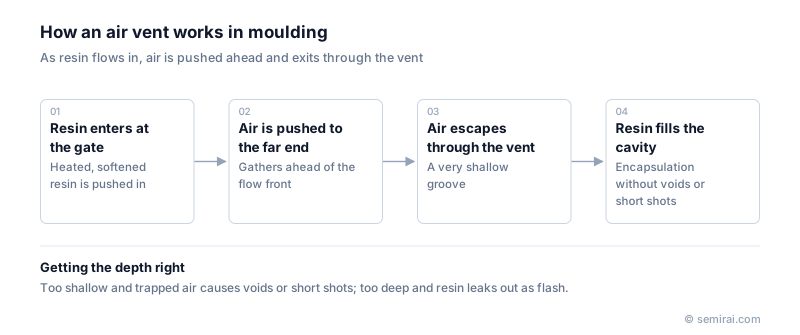
Getting the depth right
Vents are only a few tens of micrometres deep. At that depth air and gas can pass, but viscous, filler-laden mould compound cannot easily follow, so the air escapes and the resin stays in the cavity.
If a vent is too shallow or becomes blocked, air is trapped. The result is voids in the resin or incomplete filling, called a short shot, where the resin never reaches the end of the cavity. If a vent is too deep, resin leaks into it and forms thin flash that must be removed later.
Placement and maintenance
Vents are placed where the resin flow ends, and flow simulation is used to decide their number and position.
During production, resin residue and release agents gradually clog the vents, so regular mould cleaning is essential. Vacuum moulding, which evacuates the cavity before resin is injected, reduces trapped air further and is used for packages that are prone to voids.
Japanese companies involved
- TOWA and Apic Yamada build moulding systems and moulds for semiconductor packages, in which gate, runner and vent design determine filling quality.
- TOWA · Molding (encapsulation) equipment for chip packaging
- Apic Yamada (Yamaha Robotics) · Molding (encapsulation) equipment for semiconductor packages
FAQ
What happens when a vent clogs?
Air and gas cannot escape, so voids remain in the resin or the cavity is not completely filled. Voids weaken moisture resistance and insulation, so moulds are cleaned on a schedule to keep vents open.
How is vent depth chosen?
It is set so that gas passes but resin does not. The right depth depends on the compound's viscosity and the size of its silica filler particles: too deep and flash forms, too shallow and air stays trapped.
Related pages
Sources
Last updated: November 13, 2026