Molding Equipment
Molding equipment is the back-end machinery that encapsulates semiconductor chips in epoxy molding compound to protect them from the environment. The two main types are transfer molding machines and compression molding machines, chosen according to the package type, its thickness and the production volume.
Also called: encapsulation equipment, mold system, transfer molding machine, compression molding machine
Diagram
What happens inside the machine
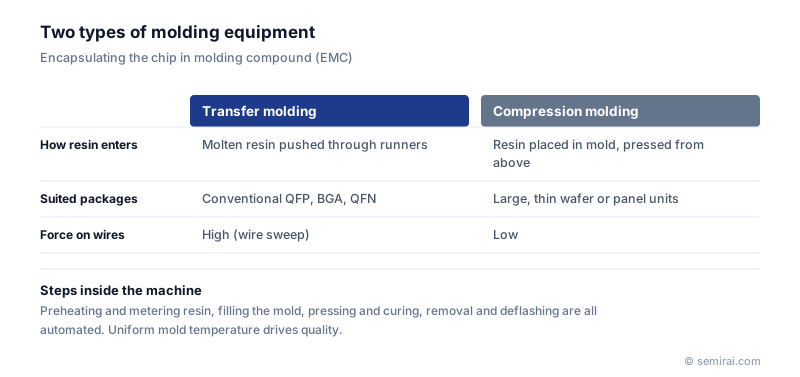
A modern molding system is fully automated. It loads lead-frame strips, substrates or wafers, preheats and meters the compound, fills the heated mold, holds pressure while the compound cures, then opens the mold, removes the parts and cleans away excess resin. Mold temperature must be uniform, because uneven curing causes warpage and incomplete filling.
Package quality depends on how the compound flows. Engineers use flow simulation to design gates and vents, and control injection speed and pressure, to avoid voids, incomplete fill and wire sweep, where flowing resin pushes bond wires against each other.
Transfer and compression molding
Transfer molding pushes molten compound from a pot through runners and gates into closed cavities. It is fast and proven, and remains the workhorse for QFP, QFN, SOP and many BGA packages.
Compression molding places compound, as granules, liquid or sheet, directly in the cavity and presses it as the mold closes. The resin moves only a short distance, so it exerts little force on wires and fills thin, large areas evenly with little waste. It is used for fan-out wafer- and panel-level packages, packages with long stacked-die wires and molded underfill. As packages grow larger and thinner, demand for compression molding has grown.
Japanese companies involved
- TOWA makes transfer and compression molding equipment and is known for its compression molding technology.
- Apic Yamada (Yamaha Robotics) also builds molding systems and the precision molds they use.
- TOWA · Molding (encapsulation) equipment for chip packaging
- Apic Yamada (Yamaha Robotics) · Molding (encapsulation) equipment for semiconductor packages
FAQ
Why is compression molding used for wafer-level packages?
A reconstituted wafer or panel is a large, thin area with dies embedded in it. Pressing compound vertically avoids long horizontal flow, so the dies do not shift much and the surface stays flat, which is essential before building redistribution layers.
What are common molding defects?
Incomplete fill, voids, wire sweep, flash (thin resin leaking at mold joints), warpage and delamination between compound and lead frame or die. They are found by visual, X-ray and acoustic inspection.
Related pages
Sources
Last updated: November 1, 2026