Aluminium Nitride (AlN)
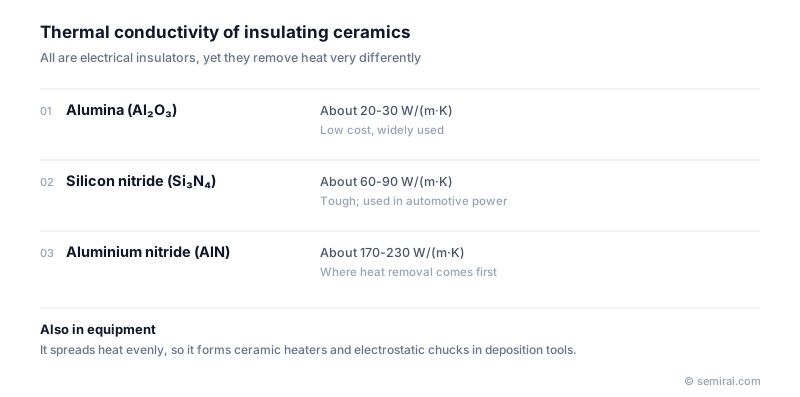
Aluminium nitride (AlN) is a compound of aluminium and nitrogen that does not conduct electricity but conducts heat very well. Sintered AlN ceramic typically reaches about 170 to 230 W/(m·K), several times that of alumina, which makes it a material of choice where heat must be removed through an electrical insulator.
Also called: aluminum nitride, AlN
Diagram
Three roles in semiconductors
First, AlN is used as the insulating substrate in power modules. The chip sits on a metallised AlN plate that carries heat away to the heat sink while isolating the high voltage. Second, it is used in manufacturing equipment. AlN resists high temperature and plasma and spreads heat evenly, so it forms the body of ceramic heaters and electrostatic chucks that hold and heat wafers in deposition and etch tools.
Third, AlN is used as a thin film. It is a wide-bandgap semiconductor with a bandgap of about 6.2 eV. It is the first layer, or nucleation and buffer layer, when GaN is grown on silicon, and AlGaN alloys with a high aluminium content are used for deep-ultraviolet LEDs. AlN is also piezoelectric, so thin AlN films form the resonators of BAW (bulk acoustic wave) filters in smartphones.
Strengths and weaknesses
AlN's thermal expansion coefficient, about 4.5 ppm/K, is close to that of silicon, so thermal stress between chip and substrate is small. Its main weaknesses are cost, which is higher than alumina, and its tendency to react slowly with moisture, so powders and surfaces have to be protected. Where mechanical toughness matters more than maximum heat conduction, such as automotive power modules exposed to heavy thermal cycling, silicon nitride (Si₃N₄) ceramic is often chosen; it conducts heat less well than AlN but resists cracking better.
Japanese companies involved
- Tokuyama produces AlN powder and related materials.
- NGK Insulators makes ceramic heaters and electrostatic chucks for wafer processing equipment, and Kyocera makes AlN substrates and packages.
- Tokuyama · Polysilicon and electronic chemicals
- NGK Corporation · Electrostatic chucks, ceramic heaters and susceptors
- Kyocera · Package substrates and ceramic components
FAQ
How does AlN compare with alumina?
Both are insulating ceramics, but AlN conducts heat several times better: about 170 to 230 W/(m·K) against roughly 20 to 30 W/(m·K) for alumina. Alumina is cheaper and easier to process, so it is used where heat load is modest, while AlN is chosen for high-power modules and equipment heaters.
Is AlN an insulator or a semiconductor?
Both descriptions are used. Its bandgap of about 6.2 eV is so large that bulk AlN behaves as an insulator, which is how it is used in ceramics. As a crystalline thin film, it is treated as an ultra-wide-bandgap semiconductor for deep-UV emitters and GaN buffer layers.
Related pages
- Power Module
- Electrostatic Chuck (ESC)
- GaN-on-Silicon (GaN-on-Si)
- Wide Bandgap Semiconductor (WBG)
- Buffer Layer
- Wurtzite Structure
- Semiconductor materials (wafers and substrates)
- Shin-Etsu Chemical 300 mm silicon wafers
- SUMCO Polished wafers (PW)
- Sumitomo Electric Industries (compound semiconductors) GaAs and InP substrates
Sources
Last updated: November 12, 2026