Arsine (AsH3)
Arsine (AsH3) is a colourless gas of one arsenic atom bonded to three hydrogen atoms. It is used to add arsenic to silicon to make it n-type and as the arsenic source for growing the compound semiconductor gallium arsenide (GaAs). In silicon processing it feeds ion implanters and epitaxial reactors; in GaAs growth it reacts with trimethylgallium in MOCVD.
Also called: arsenic trihydride, AsH3
Diagram
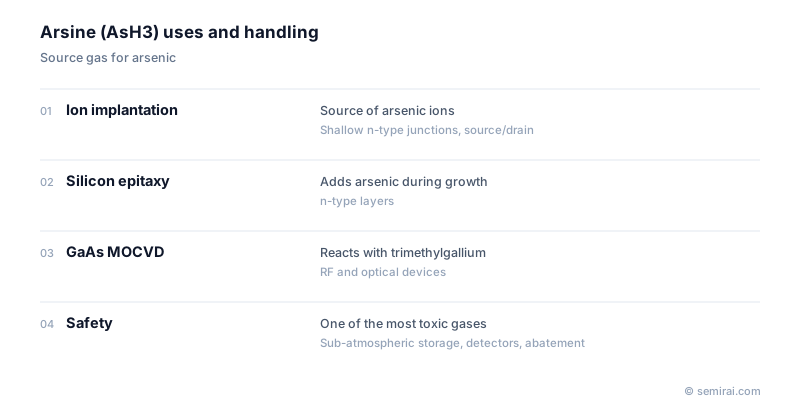
Where arsine is used
In ion implantation, arsine is broken down in the ion source to produce arsenic ions. Because arsenic is heavy and diffuses slowly, it is used for shallow n-type junctions such as the source and drain of nMOS transistors. In silicon epitaxy, arsine is added to the growth gas to dope n-type layers in situ.
In MOCVD, arsine and an organometallic gallium source such as trimethylgallium react on a heated substrate to grow GaAs. The same chemistry with aluminium or indium sources gives AlGaAs and InGaAs. These materials are used in RF devices and optoelectronics such as laser diodes.
Toxicity and safety systems
Arsine is among the most toxic gases used in semiconductor manufacturing. Inhaling even a very small amount destroys red blood cells and causes severe poisoning. It is strictly controlled as a special high-pressure gas under Japanese law, and its use requires continuous gas detection, automatic shut-off valves and abatement of tool exhaust.
For ion implantation, as with phosphine, sub-atmospheric storage cylinders are widely used to reduce the risk of a leak. For MOCVD, less toxic liquid organic arsenic sources such as tertiarybutylarsine have been studied, but arsine remains in wide use because of its purity and cost.
Japanese companies involved
- Taiyo Nippon Sanso supplies specialty gases and gas supply systems to semiconductor fabs, and makes MOCVD equipment for compound semiconductor growth.
- Taiyo Nippon Sanso · Specialty gases, gas supply systems and MOCVD equipment
FAQ
Why is arsine so dangerous?
Arsine causes haemolysis, the destruction of red blood cells, at very low concentrations, and it can be harmful below the level at which its faint garlic-like odour is noticed. Fabs therefore rely on gas detectors that monitor continuously and cut the supply as soon as a leak is detected.
Why is so much arsine used in GaAs growth?
Arsenic evaporates easily from the hot GaAs surface. To keep the crystal stoichiometric, MOCVD runs with a large excess of arsine compared with the gallium source, typically a high group V to group III ratio.
Related pages
Sources
Last updated: November 13, 2026