Carbon Tetrafluoride (CF4)
Carbon tetrafluoride (CF4) is a colourless gas of one carbon atom bonded to four fluorine atoms, the simplest perfluorocarbon (PFC). It is used as a dry etching gas for silicon oxide, silicon nitride and silicon, and in the past it was also used to clean CVD chambers. In a plasma it breaks into fluorine atoms and fragments such as CF3 that react with the film.
Also called: tetrafluoromethane, PFC-14, CF4
Diagram
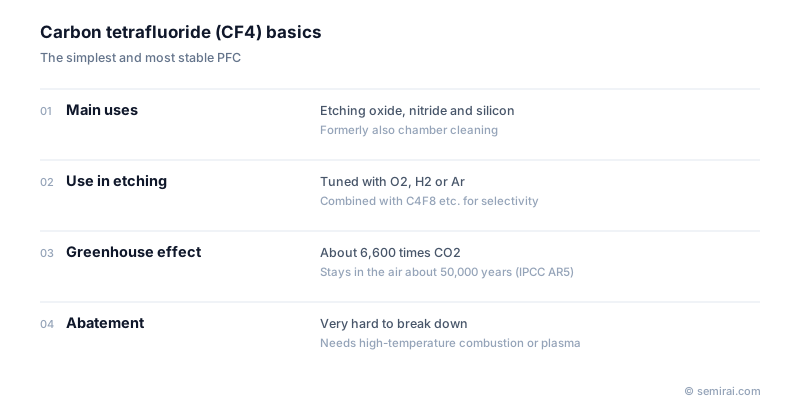
How CF4 is used in etching
CF4 is rarely used alone. Oxygen, hydrogen, argon and other gases are added to tune the etch rate and the selectivity, meaning how fast the target film etches compared with the film that must remain. Oxygen consumes carbon and increases the free fluorine, speeding the etch; hydrogen does the opposite and helps polymer formation.
Carbon-rich gases such as C4F8 and C4F6 deposit a carbon-fluorine polymer on sidewalls and on underlying layers, which allows oxide to be etched deep and selectively. CF4 forms little polymer and etches more aggressively, so engineers combine it with these gases according to the profile and selectivity they need.
Why CF4 is a problem for the climate
The CF4 molecule is extremely stable. It stays in the atmosphere for about 50,000 years and has a 100-year global warming potential of about 6,600 times that of carbon dioxide (IPCC Fifth Assessment Report).
The same stability makes it hard to destroy. CF4 survives the etch plasma largely intact, and it can even form when other PFCs break apart and recombine. Abatement needs very high temperatures or intense plasma, so CF4 is one of the hardest PFCs to remove from fab exhaust.
Japanese companies involved
- Kanto Denka Kogyo produces fluorine-based specialty gases used in semiconductor etching.
- Taiyo Nippon Sanso supplies specialty gases and gas supply systems to semiconductor fabs.
- Kanto Denka Kogyo · Fluorine-based specialty gases
- Taiyo Nippon Sanso · Specialty gases, gas supply systems and MOCVD equipment
FAQ
How does CF4 differ from C4F8?
Both are fluorocarbon etch gases, but C4F8 has a higher carbon-to-fluorine ratio and readily deposits protective polymer on sidewalls and underlying layers. CF4 forms little polymer and acts more as a pure etchant. Process recipes mix them to reach the required profile and selectivity.
Why is CF4 so hard to abate?
The carbon-fluorine bond is one of the strongest single bonds in chemistry, and CF4 has four of them in a symmetric molecule. Breaking it down by combustion or plasma requires temperatures well above 1,000 °C or a large energy input, and other PFCs can recombine into CF4 during treatment.
Related pages
Sources
Last updated: November 12, 2026