Aspect Ratio Dependent Etching (ARDE)
ARDE (aspect ratio dependent etching) is the dry etching phenomenon in which etching slows as the aspect ratio, the ratio of depth to width, of a hole or trench increases. On the same wafer, narrow features etch less deeply than wide ones, and every feature slows as it gets deeper. It is also called RIE lag.
Also called: ARDE, RIE lag
Diagram
Causes
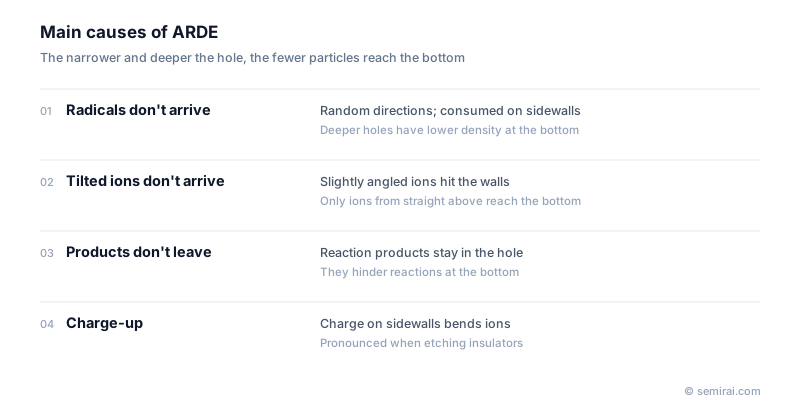
The underlying cause is that fewer particles reach the bottom of a deep, narrow feature. Radicals, the neutral reactive species that do much of the etching, move in random directions, so many hit the sidewalls and are consumed before reaching the bottom. Ions that arrive even slightly off vertical also strike the walls.
In addition, reaction products formed at the bottom have difficulty leaving the hole and interfere with further etching. When sidewalls are insulating, charge builds up on them and bends the paths of incoming ions, which slows the etch further.
Effects and countermeasures
Strong ARDE means features of different widths, or at different places on the wafer, reach different depths. Some holes fail to open, while wide features overetch into the layer below. In 3D NAND channel holes, which pass through hundreds of layers with aspect ratios of several tens to one, ARDE is one of the hardest problems.
It is reduced by raising ion energy, lowering pressure so that particles travel straighter, adjusting gas composition and wafer temperature, and pulsing the plasma to release built-up charge.
Japanese companies involved
- Tokyo Electron (TEL) makes high-aspect-ratio etch systems for memory production, where suppressing ARDE in deep holes is a central requirement.
- Tokyo Electron (TEL) · Coat/develop, etch and deposition equipment
FAQ
How does ARDE differ from the microloading effect?
ARDE describes rate changes caused by the aspect ratio of each individual feature. Microloading describes rate changes caused by local pattern density, where dense areas consume more reactive gas. Both cause uneven depths, and in practice they appear together.
What is inverse ARDE?
It is the opposite case, where narrow features etch faster than wide ones. It can occur when the species that form a protective film reach narrow holes less easily, so wide holes receive a thicker film at the bottom and etch more slowly. Engineers sometimes tune conditions between the two to make depths match.
Related pages
Sources
Last updated: November 13, 2026