RIE (Reactive Ion Etching)
RIE (reactive ion etching) is the main form of plasma dry etching. Reactive radicals from the plasma react chemically with the film, while ions accelerated toward the wafer strike it vertically. Because the ions speed up the reaction only where they land, the etch proceeds downward much faster than sideways, which lets fine patterns be cut with nearly vertical walls that wet etching cannot achieve.
Also called: reactive ion etching, reactive ion etch
Diagram
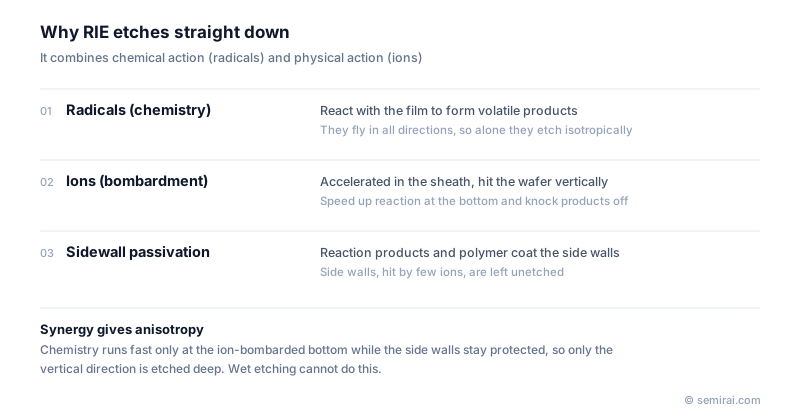
How RIE removes material
Reactive gases are fed into a vacuum chamber and ionised with RF power. The wafer sits on the powered electrode, where a negative self-bias builds up, so positive ions are accelerated across the sheath and arrive almost perpendicular to the surface. Typical gases are fluorocarbons such as CF₄, CHF₃ and C₄F₈ for silicon oxide and nitride, SF₆ for silicon, and chlorine or HBr for silicon and metals.
Radicals alone would etch in all directions, and ions alone would only sputter slowly. Together they etch far faster than either: ion impact breaks bonds and removes reaction products at the bottom of a feature, so the chemical reaction runs mainly where the ions land. Meanwhile, polymer and reaction products deposit on the side walls, where few ions hit them, and protect them from lateral etching. The balance between etching and deposition sets profile, selectivity and etch rate.
Main variants
In the original parallel-plate RIE a single RF supply sets both plasma density and ion energy, so the two cannot be tuned independently. Modern tools separate them. Inductively coupled (ICP) systems generate dense plasma with a coil and apply a separate bias to the wafer; dual-frequency capacitively coupled systems use one frequency for density and another for ion energy.
Deep reactive ion etching (DRIE), including the Bosch process that alternates etching and passivation steps, cuts silicon tens to hundreds of micrometres deep for MEMS and through-silicon vias. Pulsing the source or bias power helps control charging and ion energy in fine features.
Challenges at advanced nodes
Etch rate tends to depend on feature size and density (aspect-ratio-dependent etching and microloading), so narrow holes etch more slowly than wide ones. Very high aspect ratio features, such as 3D NAND channel holes and DRAM capacitor holes, also suffer from bowing, twisting and incomplete etching. When only a few atomic layers of selectivity margin remain, atomic layer etching is used alongside RIE.
Japanese companies involved
- Tokyo Electron makes RIE systems, and is a major supplier of capacitively coupled etchers for dielectric films.
- Hitachi High-Tech makes conductor etch systems using microwave ECR plasma, and SAMCO makes RIE and ICP etchers mainly for compound semiconductors, MEMS and research.
- Daikin Industries and Kanto Denka Kogyo supply fluorine-based etching gases.
- Hitachi High-Tech · CD-SEM metrology, defect inspection and etch systems
- SAMCO · Plasma etching, CVD and plasma cleaning equipment
- Daikin Industries · Etching gases, fluoropolymers and fluoroelastomers
- Kanto Denka Kogyo · Fluorine-based specialty gases
- Tokyo Electron (TEL) · Coat/develop, etch and deposition equipment
FAQ
Is RIE the same as dry etching?
RIE is one kind of dry etching. Dry etching also includes purely chemical plasma or gas-phase etching, which is isotropic, and purely physical ion beam milling. In practice most pattern-transfer etching in fabs is some form of RIE.
What does selectivity mean in RIE?
Selectivity is the ratio of the etch rate of the target film to that of the mask or the layer underneath. High selectivity lets the etch stop on the underlying film without damaging it and keeps thin masks intact through deep etches.
Why are fluorocarbon gases used for oxide etching?
Fluorine reacts with silicon in the oxide to form volatile SiF₄, and carbon combines with the oxygen. The carbon-rich fragments also form a polymer that protects side walls and the underlying silicon or nitride, which gives high selectivity.
Comparisons
Related pages
Sources
Last updated: November 13, 2026