Bosch Process
The Bosch process is a dry etching method that cuts deep, vertical features into silicon by alternating, every few seconds, an etch step and a step that deposits a protective film. It is named after the German company Robert Bosch, which patented it. It is the representative method of deep reactive ion etching (DRIE) and is essential for MEMS and through-silicon vias (TSVs).
Also called: time-multiplexed deep silicon etching, DRIE Bosch process
Diagram
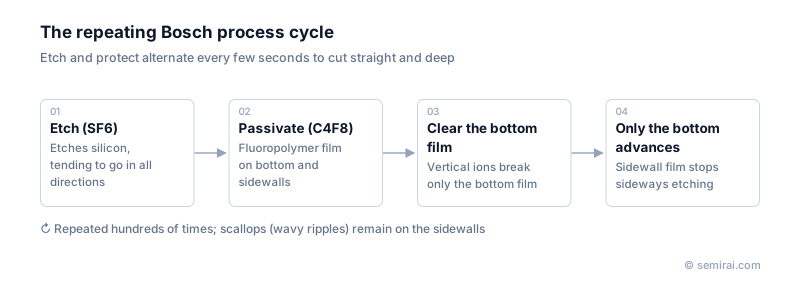
How the cycle works
In the etch step, a sulphur hexafluoride (SF₆) plasma etches silicon. Its fluorine radicals etch in all directions, so on its own the step would widen the hole sideways. In the passivation step, an octafluorocyclobutane (C₄F₈) plasma coats the bottom and sidewalls with a thin fluoropolymer film similar to PTFE.
When the process switches back to etching, ions arriving vertically remove the polymer at the bottom first, while the film on the sidewalls survives. Only the bottom is etched, so the hole advances downward. Repeating the cycle hundreds of times produces holes and trenches many tens of times deeper than they are wide, at high etch rates.
Scallops and how they are reduced
Each etch step cuts slightly sideways before the sidewall is protected again, leaving a wavy pattern on the sidewall called scalloping. In TSVs these ripples affect the barrier and seed layers and the copper fill that follow, so shorter step times are used to make the scallops smaller, at the cost of a lower etch rate. Fast gas switching and precise control of each step are therefore key features of Bosch-process tools, which are normally built around high-density ICP sources.
Japanese companies involved
- SAMCO makes ICP etch systems dedicated to the Bosch process, used for MEMS, TSVs and other deep silicon structures.
- SAMCO · Plasma etching, CVD and plasma cleaning equipment
FAQ
What is the difference between the Bosch process and DRIE?
DRIE (deep reactive ion etching) is the general name for etching deep features into silicon. The Bosch process is its most common form, defined by alternating etch and passivation steps. Another form is cryogenic DRIE, which cools the wafer far below 0 °C and etches continuously while a passivation layer forms on the sidewalls.
Can the Bosch process etch materials other than silicon?
It is designed for silicon. Fluorine radicals form volatile SiF₄ with silicon, which is what makes the fast etch step work. Oxide, glass and compound semiconductors need different chemistries and usually more ion-driven etching.
Related pages
- Deep Reactive Ion Etching (DRIE)
- MEMS (Micro-Electro-Mechanical Systems)
- Through-Silicon Via (TSV)
- Aspect Ratio
- ICP (Inductively Coupled Plasma)
- Isotropic and Anisotropic Etching
- Aspect Ratio Dependent Etching (ARDE)
- Etch Selectivity
- Dry etching equipment
- MEMS manufacturing equipment
- SAMCO RIE-400iP
- SAMCO RIE-400iPB
- SAMCO RIE-800iPB
- SAMCO VPE-4F
Sources
Last updated: November 13, 2026