Aspect Ratio
Aspect ratio is the ratio of depth to width of a fine structure such as a trench, via or contact hole. The higher the aspect ratio, the deeper and narrower the feature, and the harder it becomes both to etch it and to fill it later with deposited material. It is one of the clearest indicators of how difficult an advanced process is.
Also called: AR, high aspect ratio (HAR)
Diagram
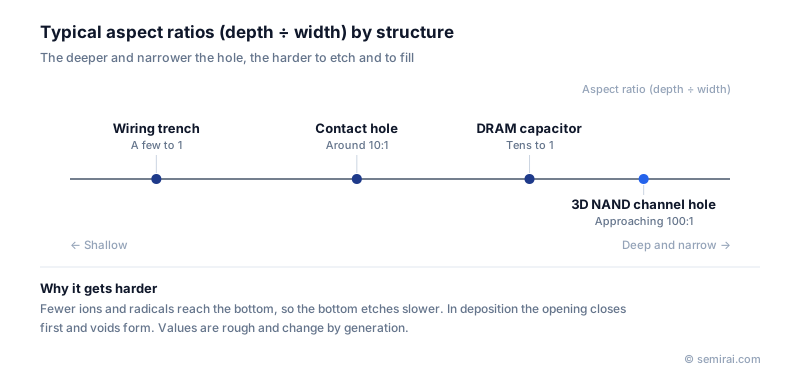
Why high aspect ratios are hard to etch
Etching a deep, narrow hole needs a highly anisotropic process. As the hole deepens, fewer radicals and ions reach the bottom: radicals are consumed on the sidewalls, slightly tilted ions hit the walls, and reaction products escape more slowly. The etch slows down, the profile can bow or taper, and in extreme cases the etch stops. Charging of insulating sidewalls can also bend incoming ions.
Deep reactive ion etching (DRIE) methods such as the Bosch process are used for very deep silicon features, while deep holes through dielectric stacks need strong, energetic ion bombardment.
Why they are hard to fill
Filling a deep hole or trench without voids is just as difficult. In ordinary deposition the opening tends to close before the bottom is filled. Atomic layer deposition (ALD), which coats all surfaces evenly, and bottom-up methods such as electroplating are used to fill high-aspect-ratio features.
Where high aspect ratios appear
The best-known example is the channel hole of 3D NAND, which passes through hundreds of stacked layers. Its aspect ratio is several tens to one and rises with each generation as more layers are added. DRAM capacitors and through-silicon vias in advanced packaging are other high-aspect-ratio structures.
Japanese companies involved
- Tokyo Electron (TEL) supplies etch and deposition equipment used for high-aspect-ratio structures in 3D NAND and DRAM.
- Tokyo Electron (TEL) · Coat/develop, etch and deposition equipment
FAQ
How high is the aspect ratio in 3D NAND?
Memory holes in current 3D NAND reach aspect ratios of several tens to one, and the industry is working toward 100:1. To limit the depth of a single etch, makers often split the stack into two or more decks that are etched separately and aligned to each other.
How is a high-aspect-ratio structure coated evenly?
ALD is the usual answer. Because each reaction step saturates on every exposed surface, it gives nearly the same film thickness at the top and bottom of a deep hole. CVD can be conformal under some conditions, but at extreme aspect ratios ALD is often the only practical option.
Related pages
Sources
Last updated: November 2, 2026