Dissociation
Dissociation is the breaking of a molecule's bonds so that it splits into smaller fragments such as atoms or radicals. In a plasma it happens when accelerated electrons collide with molecules, and it produces the radicals that drive etching and deposition chemistry. Dissociating carbon tetrafluoride (CF₄), for example, produces fragments such as CF₃ and CF₂ and fluorine atoms.
Also called: molecular dissociation, electron-impact dissociation
Diagram
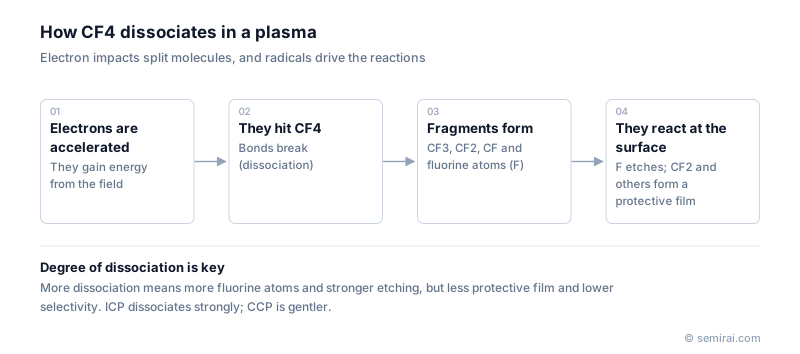
Why plasmas contain more radicals than ions
Breaking a bond usually needs less energy than removing an electron. Far more electron collisions can therefore dissociate a molecule than can ionise it, and a processing plasma contains many more radicals than ions.
Which fragments form, and how many, depends on plasma density, electron energy and pressure. This degree of dissociation strongly affects how an etch behaves.
Dissociation and etch selectivity
When oxide is etched with fluorocarbon gases, too much dissociation produces abundant fluorine atoms, which also etch the silicon underneath and lower selectivity. Moderate dissociation leaves fragments such as CF₂ that form a protective polymer on sidewalls and on the underlayer, preserving selectivity and profile.
High-density ICP plasmas tend to dissociate gases more strongly, while CCP is relatively gentle, so the choice of source and gas is a way to set the degree of dissociation. Chamber cleaning takes the opposite approach: nitrogen trifluoride (NF₃) is fully dissociated in a remote plasma source, and only the fluorine atoms are sent into the chamber to remove deposits.
Japanese companies involved
- Kanto Denka Kogyo and Daikin Industries supply fluorine-based gases used in etching and chamber cleaning, whose behaviour in a plasma depends on how they dissociate.
- Kanto Denka Kogyo · Fluorine-based specialty gases
- Daikin Industries · Etching gases, fluoropolymers and fluoroelastomers
- Tokyo Electron (TEL) · Coat/develop, etch and deposition equipment
FAQ
What is the difference between dissociation and ionisation?
Dissociation splits a molecule into neutral fragments such as atoms and radicals. Ionisation removes an electron to make a charged ion. Dissociation usually needs less energy, which is why radicals far outnumber ions in a processing plasma.
How is the degree of dissociation measured?
Optical emission spectroscopy tracks the light from species such as fluorine atoms, often using a small amount of added argon as a reference (actinometry). Mass spectrometry and laser absorption methods are also used in research to measure radical densities more directly.
Related pages
- Plasma (Semiconductor Processing)
- Ionisation
- ICP (Inductively Coupled Plasma)
- CCP (Capacitively Coupled Plasma)
- Etch Selectivity
- PECVD (Plasma-Enhanced Chemical Vapour Deposition)
- Optical Emission Spectroscopy (OES)
- Dry etching equipment
- PECVD equipment
- Tokyo Electron (TEL) Acrevia™
- Tokyo Electron (TEL) Tactras™
- Elionix EIS-200ERP
- Panasonic Connect APX300-DM
Sources
Last updated: November 13, 2026