Avalanche Capability (Avalanche Energy)
Avalanche capability is the amount of energy a power semiconductor can absorb without damage when a voltage above its breakdown voltage drives it into avalanche breakdown. Power MOSFET datasheets state it as single-pulse avalanche energy (EAS), repetitive avalanche energy (EAR) and avalanche current (IAR).
Also called: avalanche ruggedness, EAS, EAR, UIS rating
Diagram
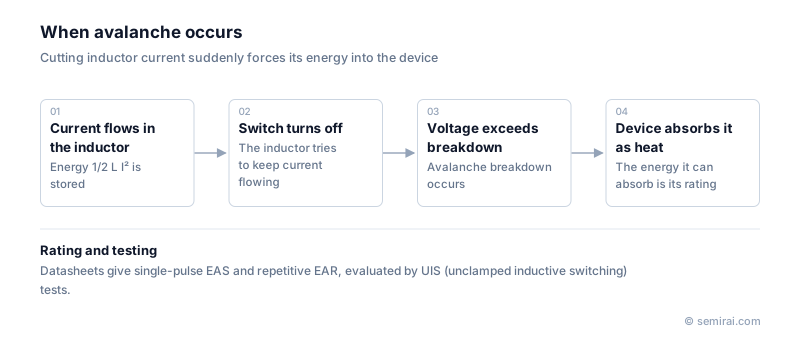
When avalanche happens
In avalanche breakdown, carriers accelerated by the strong field in the depletion region knock new electron-hole pairs out of the lattice, and the current multiplies rapidly. In real circuits this most often happens when a transistor switches off current flowing in an inductive load such as a motor, relay, solenoid or transformer winding.
An inductor resists any change in its current. When the switch opens, the inductor drives the voltage up until the current finds a path. If no clamp or diode provides one, the voltage rises past the transistor's breakdown voltage, and the energy stored in the inductor, E = 1/2 L I², is dissipated as heat inside the transistor. The standard test that reproduces this condition is unclamped inductive switching (UIS).
What limits avalanche capability
A device can fail in avalanche because its temperature rises too far, or because the parasitic bipolar transistor inside a MOSFET turns on and current collapses into a small spot. Cell structure and the edge termination that holds the voltage at the chip periphery therefore largely decide the rating.
Silicon and SiC MOSFETs are designed to survive a specified amount of avalanche energy. Lateral GaN HEMTs, by contrast, have no pn junction that can safely conduct avalanche current, so they fail without avalanching if overvoltage is large enough. They are given a large margin between rated and actual breakdown voltage instead. In all cases, good circuit design uses snubbers or clamp circuits to keep surges below the breakdown voltage, so the device never enters avalanche in normal operation.
Japanese companies involved
- ROHM and Toshiba Electronic Devices & Storage specify avalanche ratings for their power MOSFETs used in automotive and motor-drive circuits.
- ROHM · SiC and silicon power devices, analog ICs
- Toshiba Electronic Devices & Storage · Power MOSFETs, IGBTs and discrete semiconductors
FAQ
In which applications does avalanche capability matter most?
In circuits that switch inductive loads directly without a freewheeling path, such as automotive solenoid, injector and relay drivers, and some motor and lamp drivers. There the transistor itself must absorb the inductive energy at every turn-off or during faults.
Why does EAS depend on temperature and inductance?
Failure is mainly thermal, so a hotter device has less headroom and a lower rating. The inductance sets how long the avalanche lasts for a given energy; a longer, lower-current pulse heats the chip differently from a short, high-current one, so datasheets state the test conditions.
Related pages
- Breakdown Voltage
- Trench MOSFET
- SiC MOSFET (Silicon Carbide MOSFET)
- Safe Operating Area (SOA)
- Gallium Nitride (GaN)
- Body Diode
- Avalanche Breakdown
- Power semiconductor manufacturing equipment
- SiC power semiconductor equipment
- Advantest EXAVIS
- Advantest MT100 / MT200
- Hitachi High-Tech M-600 / 6000 series
- HORIBA MiPLATO-SiC
Sources
Last updated: November 13, 2026