Bipolar Junction Transistor (BJT)
A bipolar junction transistor (BJT) is a three-terminal amplifying and switching device, with emitter, base and collector, formed from two pn junctions. It is called bipolar because both electrons and holes take part in its operation. BJTs come in npn and pnp types and are current-controlled, fast and high-gain devices.
Also called: bipolar transistor, BJT, npn transistor, pnp transistor
Diagram
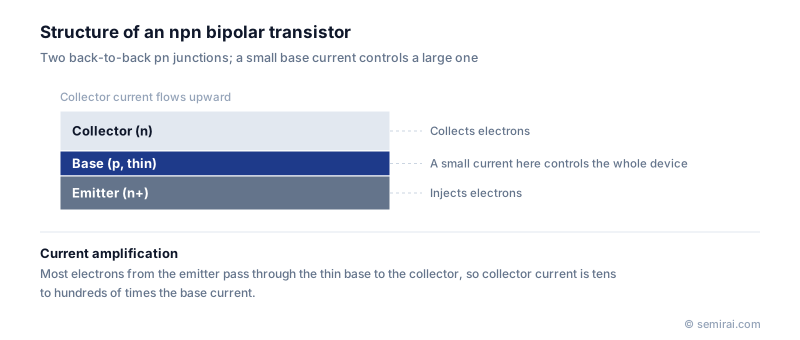
How a BJT amplifies
In normal operation the base-emitter junction is forward-biased and the base-collector junction is reverse-biased. In an npn transistor, the heavily doped emitter injects electrons into the base. The base is thin and lightly doped, so most of these electrons cross it before they can recombine, and the field of the reverse-biased junction sweeps them into the collector.
Only a small fraction of the injected carriers recombine in the base, and that small base current controls the much larger collector current. The ratio, the current gain, is typically tens to hundreds. The npn type is more common because electrons move faster than holes.
BJT vs MOSFET
A MOSFET is controlled by gate voltage and draws almost no steady input current, which makes it ideal for dense, low-power digital logic. A BJT needs a continuous base current, so it consumes more power and is harder to integrate in large numbers. That is why CMOS replaced bipolar logic in mainstream digital chips.
BJTs still have advantages. Their transconductance, the change in output current per change in input voltage, is higher than a MOSFET's at the same current, and their noise and matching are good. They remain important in analog amplifiers, precision references, and high-frequency radio circuits, where silicon-germanium (SiGe) heterojunction bipolar transistors are widely used. BiCMOS processes combine bipolar and CMOS devices on one chip.
Japanese companies involved
- Toshiba Electronic Devices & Storage makes small-signal and power bipolar transistors, and ROHM also makes bipolar transistors for general-purpose circuits.
- Toshiba Electronic Devices & Storage · Power MOSFETs, IGBTs and discrete semiconductors
- ROHM · SiC and silicon power devices, analog ICs
- Renesas Electronics · Microcontrollers, automotive SoCs, analog and power chips
FAQ
What is the difference between npn and pnp?
The order of the layers is reversed, so the polarity of the voltages and the main carrier are reversed too. In npn devices electrons carry the current; in pnp devices holes do. Circuits often pair them in complementary stages.
What is an IGBT and how is it related to the BJT?
An insulated-gate bipolar transistor (IGBT) combines a MOS gate with a bipolar output structure. It is driven by voltage like a MOSFET but conducts high current with low loss like a bipolar device, which makes it a standard power switch.
Why is the base made thin?
A thin base lets injected carriers reach the collector before they recombine, which raises current gain and shortens transit time, improving high-frequency performance.
Related pages
Sources
Last updated: November 2, 2026