X-ray Fluorescence (XRF)
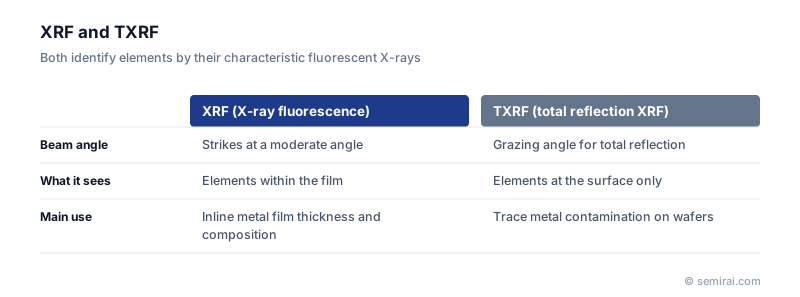
X-ray fluorescence (XRF) analysis identifies and measures the elements in a sample from the characteristic X-rays they emit when struck by an incident X-ray beam. It is non-destructive and fast, so fabs use it to measure the thickness and composition of metal films directly on product wafers.
Also called: XRF, X-ray fluorescence spectrometry, ED-XRF, WD-XRF
Diagram
How XRF works
An incoming X-ray can eject an electron from an inner shell of an atom. An electron from an outer shell then drops into the vacancy and releases the energy difference as a fluorescent X-ray. Because shell energies are fixed for each element, the energy of the fluorescent X-ray identifies the element, and its intensity indicates how much of it is present.
Energy-dispersive XRF (ED-XRF) measures the X-ray energies directly with a semiconductor detector and is compact and fast. Wavelength-dispersive XRF (WD-XRF) separates the X-rays by diffraction from an analysing crystal before counting them, giving better resolution and precision at the cost of size and speed.
Uses in chipmaking
In the fab, XRF measures the thickness and composition of metal layers such as copper, tungsten and cobalt, alloy films, and solder bumps. Calibrated against reference samples, the fluorescence intensity converts into film thickness, and automated tools map many points across each wafer.
For trace surface contamination, total reflection X-ray fluorescence (TXRF) is used. The beam strikes the wafer at a very shallow angle so it reflects instead of penetrating, which suppresses signal from the substrate. TXRF and its vapour-phase-decomposition variant are standard methods for monitoring metal contamination from cleaning and equipment.
Japanese companies involved
- Rigaku makes XRF and TXRF metrology systems for film measurement and wafer contamination analysis.
- HORIBA and Hitachi High-Tech make X-ray fluorescence analysers, including instruments for coating thickness and micro-area elemental analysis.
- Rigaku · X-ray metrology and thermal analysis
- HORIBA · Mass flow controllers and process monitoring instruments
- Hitachi High-Tech · CD-SEM metrology, defect inspection and etch systems
FAQ
Can XRF detect light elements?
Poorly. Light elements such as carbon, nitrogen and oxygen emit low-energy X-rays that are easily absorbed, and their fluorescence yield is low. XRF works best for heavier elements, so light-element films are usually measured by other methods such as ellipsometry or XPS.
How does XRF differ from EDX?
Both read characteristic X-rays, but XRF excites them with an X-ray beam and EDX with an electron beam inside an electron microscope. EDX can target a spot a micrometre or smaller, while XRF analyses a larger area with less background and no vacuum or beam damage concerns for most samples.
Related pages
Sources
Last updated: November 1, 2026