HMDS (Hexamethyldisilazane)
HMDS (hexamethyldisilazane), [(CH₃)₃Si]₂NH, is an organosilicon compound used as an adhesion promoter, or primer, before photoresist coating. Treating the wafer with HMDS keeps resist patterns from peeling during development and etching and stops chemicals from creeping under the pattern edges.
Also called: hexamethyldisilazane, adhesion promoter, primer
Diagram
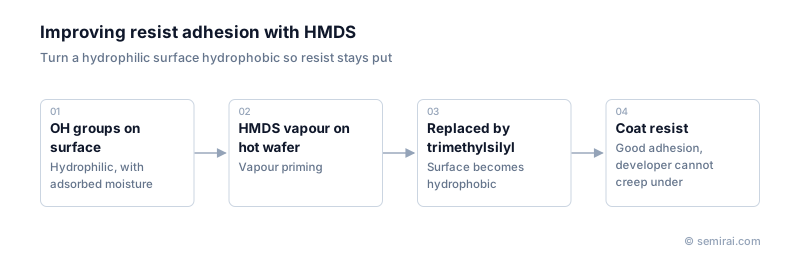
Why HMDS improves adhesion
Silicon and oxide surfaces carry many hydroxyl (-OH) groups that adsorb moisture from the air, making them hydrophilic. Organic resist wets such a surface poorly, and water or developer that gets into the interface can lift the resist off.
HMDS reacts with the surface hydroxyl groups and replaces them with trimethylsilyl groups (-Si(CH₃)₃), turning the surface hydrophobic. The result is checked by measuring the water contact angle, which increases after treatment.
How the treatment is done
The usual method is vapour priming: inside a unit of the coater/developer, the heated wafer is exposed to HMDS vapour. Compared with spinning on liquid HMDS, this gives better control of the amount applied and fewer particles. Over-treatment makes the surface repel the resist so it cannot be coated evenly, so temperature and time are controlled.
The reaction releases ammonia as a by-product. With chemically amplified resists, ammonia can neutralise the photo-generated acid and cause profile defects or scum, so exhaust and the waiting time between priming and coating also matter. In advanced processes, an underlayer such as a bottom anti-reflective coating often takes over the adhesion role.
Japanese companies involved
- Tokyo Electron's coater/developer tracks include the vapour-prime units that apply HMDS just before resist coating.
- Shin-Etsu Chemical · Silicon wafers, photoresists and photomask blanks
- Tokyo Ohka Kogyo (TOK) · Photoresists and high-purity process chemicals
- Tokyo Electron (TEL) · Coat/develop, etch and deposition equipment
FAQ
How is the effect of HMDS checked?
A drop of water is placed on the treated wafer and its contact angle is measured. A more hydrophobic surface makes the droplet bead up and raises the angle, so the treatment can be monitored numerically. Fabs keep the angle within a set window, because too high an angle also causes coating problems.
Is HMDS needed on every layer?
Not always. It matters most on bare silicon and oxide surfaces coated directly with resist. When an organic bottom anti-reflective coating or other underlayer is applied first, the resist adheres to that layer instead, and separate HMDS priming may be unnecessary.
Related pages
Sources
Last updated: November 1, 2026