Lightly Doped Drain (LDD)
A lightly doped drain (LDD) is a MOSFET structure in which only the part of the source and drain next to the gate edge has a low dopant concentration. It reduces the electric field peak at the drain edge and so suppresses hot-carrier degradation. It came into use around 1980 as transistors shrank.
Also called: LDD, source/drain extension
Diagram
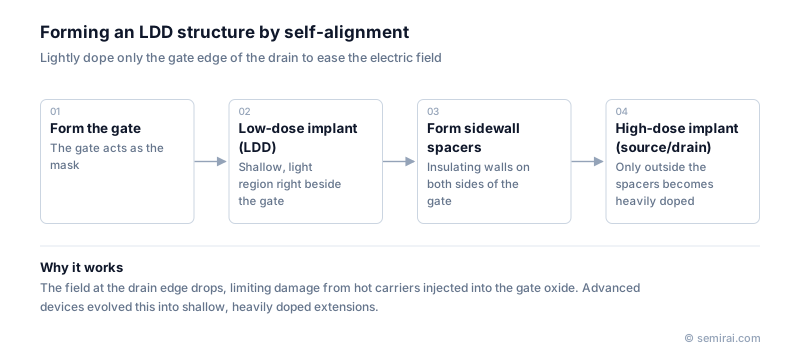
Why the drain field matters
As transistors shrink, the electric field near the drain becomes very strong. Electrons accelerated by it become hot carriers with high energy; some are injected into the gate oxide and trapped there, and the threshold voltage and current drift over time. A lightly doped region between the channel and the heavily doped drain spreads the voltage drop over a longer distance and lowers the peak field.
How it is made
LDD is formed in a self-aligned way. After the gate is patterned, a low-dose implant uses the gate as a mask to dope shallow regions right next to it. Insulating sidewall spacers are then formed on both sides of the gate, and a high-dose source/drain implant dopes only the area outside the spacers. The spacer width sets the length of the light region without an extra mask.
The light region adds resistance and reduces drive current. In later generations it became the source/drain extension (SDE): still shallow, but more heavily doped. Today's extensions use low-energy arsenic or boron implants combined with halo (pocket) implants that suppress short-channel effects. In high-voltage and power MOSFETs, lightly doped drain regions for field relief remain essential.
Japanese companies involved
- Sumitomo Heavy Industries Material Solutions (formerly SMIT) and Nissin Ion Equipment make ion implanters used for low-dose LDD, extension and halo implants.
- Nissin Ion Equipment · Ion implanters
- Sumitomo Heavy Industries Material Solutions (formerly SMIT) · Ion implanters
FAQ
What is the difference between LDD and a source/drain extension?
Both are shallow regions at the gate edge. LDD is deliberately lightly doped to relieve the electric field. An extension is doped much more heavily to keep resistance low in very short transistors, and relies on lower supply voltages and halo implants to control the field and short-channel effects.
What is a halo implant?
A halo or pocket implant places dopant of the opposite type to the source/drain just under the gate edges, usually with a tilted beam. It limits how far the source and drain depletion regions spread into the channel, which reduces threshold voltage roll-off in short transistors.
Why are spacers important for LDD?
The spacer shields the area next to the gate from the heavy source/drain implant, so its width directly sets the length of the lightly doped region. This self-alignment makes the structure reproducible without an extra lithography step.
Related pages
Sources
Last updated: November 2, 2026