Fumed Silica
Fumed silica is a very fine silicon dioxide powder made by burning silicon tetrachloride (SiCl₄) in a hydrogen and oxygen flame. Its tiny primary particles fuse into branched, grape-like aggregates. It has long been used as the abrasive in CMP slurries for oxide and is also widely used as a thickening additive outside semiconductors.
Also called: pyrogenic silica, dry-process silica
Diagram
Use in CMP
Fumed silica slurries were a standard choice for interlayer dielectric (oxide) CMP. The irregular aggregates remove oxide efficiently, making it easy to reach a high removal rate.
The drawback is that coarse aggregates can scratch the wafer, so the slurry must be well dispersed and large particles must be filtered out. As interconnects shrank and scratch requirements tightened, some applications moved to colloidal silica or ceria.
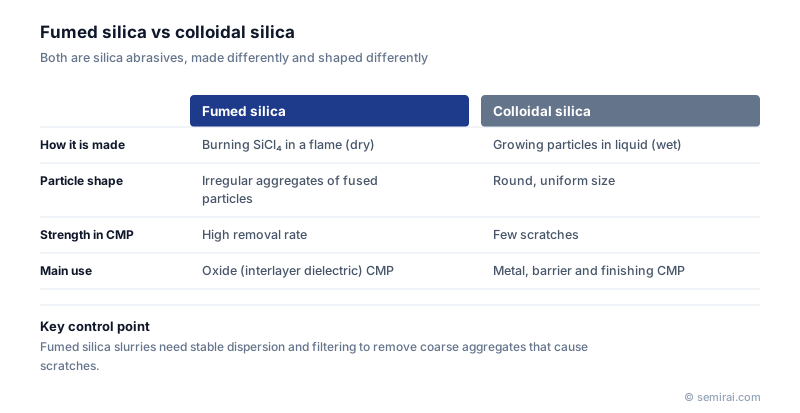
Fumed silica vs colloidal silica
Colloidal silica is grown as round particles in liquid, while fumed silica is formed in a flame as a dry powder of aggregates. In CMP, fumed silica tends to give higher removal rates, and colloidal silica, with its uniform round particles, tends to give fewer scratches. The choice depends on whether speed or defect level matters more for a given step.
Outside polishing, fumed silica is added to encapsulants, adhesives, coatings and silicone rubber. A small amount makes a liquid thixotropic, meaning it stays put at rest but flows when stirred or pushed, and it also reinforces silicone rubber.
Japanese companies involved
- Tokuyama produces fumed silica as part of its silicon chemicals business.
- Fujimi Incorporated supplies CMP slurries using silica abrasives.
- Tokuyama · Polysilicon and electronic chemicals
- Fujimi Incorporated · CMP slurries and polishing materials
FAQ
What is the difference between fumed silica and colloidal silica?
Fumed silica is a dry powder made in a flame, with irregular aggregates of fused particles. Colloidal silica is made wet, with round, separate particles of uniform size. In CMP the first favours removal rate, the second favours low scratching.
Why must fumed silica slurries be filtered?
The aggregates can stick together into larger clusters during storage and delivery. These hard clusters scratch the wafer, so slurry systems keep the particles dispersed and use filters to remove oversized clusters before the slurry reaches the pad.
Related pages
Sources
Last updated: November 13, 2026