CMP Slurry
CMP slurry is the polishing liquid used with a polishing pad in chemical mechanical polishing (CMP) to flatten the wafer surface. It is a suspension of nanometre-scale abrasive particles in a chemical solution, so material is removed by mechanical abrasion and chemical reaction at the same time, and its recipe is tuned to the film being polished.
Also called: polishing slurry, CMP abrasive slurry
Diagram
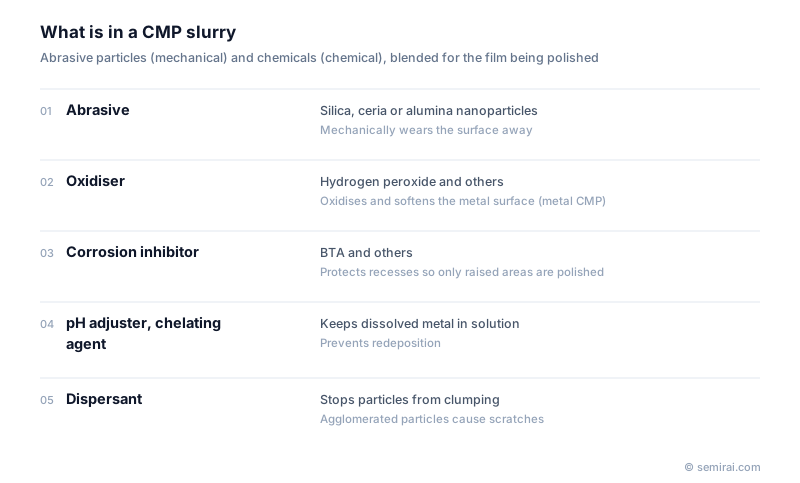
What is in a slurry
The abrasive is usually colloidal or fumed silica (SiO₂), ceria (CeO₂) or alumina (Al₂O₃), with primary particles in the range of roughly ten to a hundred nanometres. The particles scrape the surface, but on their own they would remove material slowly and leave scratches.
The liquid does most of the selective work. Oxidisers such as hydrogen peroxide convert a metal surface into a softer oxide that the particles can wipe away. Complexing (chelating) agents keep dissolved metal in solution so it does not redeposit. Corrosion inhibitors such as benzotriazole (BTA) form a thin protective film, so recessed areas are protected while raised areas, which feel more pad pressure, are polished. pH adjusters and dispersants keep the particles charged and separated, because agglomerated particles are a major cause of scratches.
Slurry types by application
Each CMP step uses its own slurry. Interlayer dielectric (oxide) polishing traditionally uses silica in an alkaline solution. Shallow trench isolation (STI) CMP uses ceria slurries with additives that give a high removal-rate ratio of oxide to silicon nitride, so polishing effectively stops on the nitride layer.
Copper CMP uses silica abrasive with an oxidiser, a complexing agent and BTA, and the challenge is to remove copper quickly while keeping dishing (copper sagging in wide lines) and erosion (thinning of dense line arrays) small. A separate barrier slurry then removes the tantalum-based barrier with controlled selectivity to copper and the dielectric. Tungsten plug CMP was first done with alumina slurries and now commonly uses oxidiser-based silica slurries.
Why slurry quality matters
Slurry composition sets removal rate, selectivity and defect levels, so it directly affects yield. Fabs filter slurry at the point of use to remove oversized particles and agglomerates, monitor large-particle counts, and control mixing and storage carefully. Spent slurry is a significant wastewater stream that has to be treated.
Japanese companies involved
- Fujimi Incorporated makes CMP slurries and polishing compounds, including slurries for silicon wafer polishing.
- Resonac (formerly Hitachi Chemical and Showa Denko Materials) supplies CMP slurries, including ceria-based slurries for oxide and STI polishing.
- AGC sells CMP slurries alongside its glass and electronic materials businesses.
- Resonac · CMP slurries, packaging materials and SiC epitaxial wafers
- AGC · EUV mask blanks and glass materials
- Fujimi Incorporated · CMP slurries and polishing materials
FAQ
Why is ceria used for STI polishing instead of silica?
Ceria reacts chemically with silicon dioxide, so it removes oxide efficiently at low particle loading. With suitable additives it polishes oxide much faster than silicon nitride, which lets the process stop on the nitride layer that protects the active areas.
What causes scratches in CMP?
Most scratches come from oversized particles: agglomerated abrasive, dried slurry flakes or pad debris. Point-of-use filters, stable dispersion chemistry and keeping slurry from drying on lines and nozzles are the main countermeasures.
Is the slurry reused?
Normally slurry is used once and drained, because its chemistry and particle size distribution change during polishing. Some fabs recover water or abrasive from the waste, but recycled slurry is rarely used for critical device layers.
Related pages
Sources
Last updated: November 2, 2026