Abrasive
An abrasive is a hard, fine particle used to remove material by polishing or grinding. In semiconductor manufacturing abrasives appear in CMP slurries, in silicon wafer lapping and polishing, and in the grinding wheels and dicing blades used to thin and cut wafers. Their material, size, shape and hardness set the removal rate and the surface quality.
Also called: abrasive grain, abrasive particle
Diagram
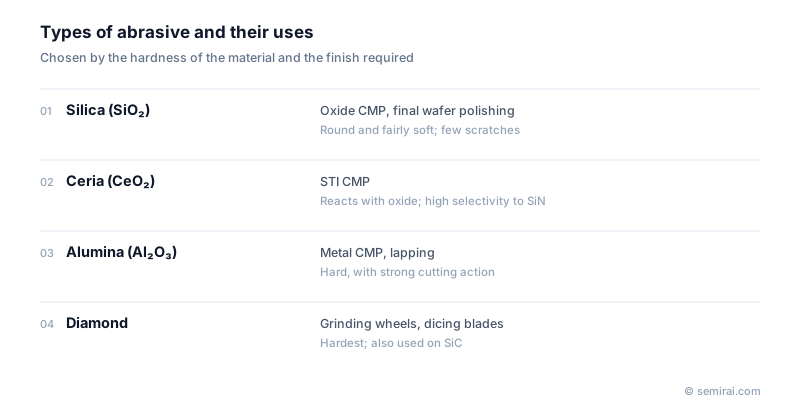
Main abrasive materials
Silica (SiO₂), as colloidal or fumed silica, is the most widely used abrasive for oxide, copper and tungsten CMP and for the final polish of silicon wafers. Ceria (cerium oxide, CeO₂) reacts chemically with silicon oxide, so it removes oxide quickly with little abrasive and can polish oxide selectively over nitride, which is why it is used for shallow trench isolation (STI) CMP.
Alumina (Al₂O₃) is hard and has been used for metal CMP and lapping. Diamond, the hardest material, is used in back-grinding wheels, dicing blades and in machining hard substrates such as silicon carbide.
Loose and fixed abrasives
Abrasives are used either loose, dispersed in a liquid and combined with a pad, or fixed, bonded with resin or metal into a wheel or blade. In CMP slurries the average size matters, but the main cause of deep scratches is the very small number of oversized particles and agglomerates. Their count is tightly specified and filters remove them just before use.
In wheels and blades, the diamond grit size and the bond material are chosen to balance cutting speed against surface roughness and edge chipping.
Japanese companies involved
- Fujimi Incorporated and Resonac supply CMP slurries built around silica and ceria abrasives.
- DISCO makes dicing blades and grinding wheels, and Asahi Diamond Industrial makes diamond dicing blades, grinding wheels and CMP pad conditioners.
- Fujimi Incorporated · CMP slurries and polishing materials
- Resonac · CMP slurries, packaging materials and SiC epitaxial wafers
- DISCO · Dicing, grinding and polishing equipment
- Asahi Diamond Industrial · Dicing blades, grinding wheels and CMP pad conditioners
FAQ
How are ceria and silica used differently in CMP?
Silica is the general-purpose abrasive for oxide and metal CMP and for wafer finishing. Ceria bonds chemically with oxide, gives high removal rates at low particle loading and can be made highly selective to nitride, so it is chosen for STI and other steps that must stop on nitride.
Why are a few large particles more important than the average size?
A single oversized particle or hard agglomerate trapped under the wafer can gouge a deep scratch across many chips. The average size mostly affects removal rate, but defect levels depend on the tail of the size distribution, so suppliers specify large-particle counts separately.
Related pages
Sources
Last updated: November 12, 2026