Native Oxide
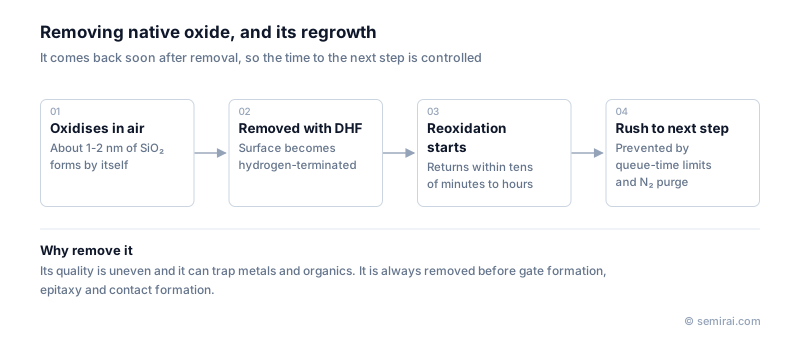
Native oxide is the thin silicon dioxide (SiO₂) layer, roughly 1-2 nm thick, that grows by itself when a silicon surface is exposed to oxygen and moisture in air or in rinse water. Because it is not grown under control, its quality is poor and it can trap metals and organics, so it is removed before steps that need a clean silicon surface.
Also called: native silicon oxide, natural oxide
Diagram
Why native oxide is a problem
Many steps depend on an atomically clean silicon interface. If native oxide remains before gate dielectric formation, the interface has more defects. Before epitaxial growth it disturbs the crystal template and causes defects in the new layer. At the bottom of contact holes it raises contact resistance and interferes with silicide formation. A pre-clean that removes the oxide is therefore placed immediately before each of these steps.
The film grows quickly at first and then slows down, because oxygen and water have to move through the oxide already present. Humidity, temperature and the chemicals the wafer has seen all change how fast it forms.
Removing it: wet and dry methods
The standard method is a dip in dilute hydrofluoric acid (DHF). HF dissolves SiO₂ but hardly attacks silicon, and it leaves the surface terminated with hydrogen (Si-H bonds). This hydrogen-terminated surface repels water and resists oxidation for a while, but in air it begins to reoxidise within tens of minutes to a few hours.
For fine structures where liquids cause pattern collapse or water marks, dry oxide removal is used. In chemical oxide removal (COR), HF and ammonia gases convert the oxide into a solid ammonium fluorosilicate layer, which is then sublimated by heating. The process removes oxide in small, controllable amounts and can be integrated in a vacuum cluster tool with the next deposition step, so the wafer never sees air.
Queue time and nitrogen purging
Because the oxide grows back, fabs set a queue-time (Q-time) limit between the pre-clean and the next step. Wafers that exceed it are cleaned again. While waiting they are kept in nitrogen-purged FOUPs or stockers, and equipment front ends may be filled with nitrogen to reduce exposure to oxygen and moisture during transfer.
Japanese companies involved
- SCREEN Holdings and Tokyo Electron make the single-wafer and batch wet cleaning tools in which HF pre-cleans are carried out.
- Stella Chemifa supplies high-purity hydrofluoric acid used for oxide removal and cleaning.
- SCREEN Holdings · Wafer cleaning, coat/develop and inspection equipment
- Tokyo Electron (TEL) · Coat/develop, etch and deposition equipment
- Stella Chemifa · High-purity hydrofluoric acid and fluorine chemicals
FAQ
How thick does native oxide get?
In clean-room air it typically levels off at around one nanometre or a little more, reached over hours to days; it grows faster in water and humid air. It is thin, but at the scale of modern gate dielectrics and contacts even a fraction of a nanometre matters.
Is native oxide ever useful?
Occasionally. The chemical oxide formed by SC1 or ozone cleaning is used as a thin, uniform starting layer for some gate stacks, and a thin oxide protects the surface during storage. The problem is the uncontrolled oxide formed in air, not oxide as such.
Do other materials have native oxides?
Yes. Most metals and many compound semiconductors oxidise in air, including aluminium, copper, titanium, gallium arsenide and germanium. Their oxides are removed before bonding, contact formation or regrowth for the same reason.
Related pages
- Epitaxy (Epitaxial Growth)
- Gate Oxide (Gate Dielectric)
- EFEM (Equipment Front End Module)
- Oxide Film (Silicon Dioxide)
- Chemical Shift (XPS)
- X-ray Photoelectron Spectroscopy (XPS)
- SC1 Cleaning (APM)
- Hydrophilicity and Hydrophobicity
- Dry cleaning equipment
- SCREEN Holdings SU-3200
- Tokyo Electron (TEL) ANTARES™
- Tokyo Electron (TEL) Certas LEAGA™
- Iwasaki Electric OC-2503 / OC-2506 / OC-4012
Sources
Last updated: November 13, 2026