Colloidal Silica
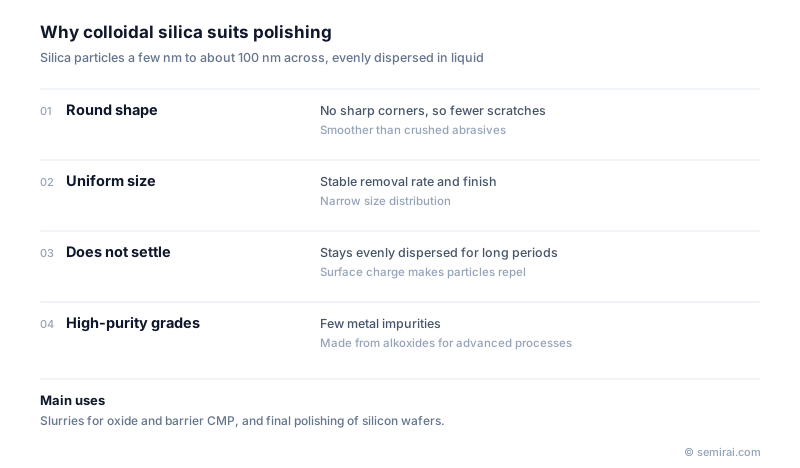
Colloidal silica is a liquid in which fine particles of silicon dioxide (SiO₂), roughly a few nanometres to about 100 nm across, are evenly dispersed without settling. In semiconductor manufacturing it is the abrasive in many CMP slurries and the polishing agent for the final mirror polish of silicon wafers.
Also called: silica sol
Diagram
How it is made
The particles carry surface charge and repel each other, which keeps them dispersed for long periods. There are two main production routes. In the first, sodium is removed from sodium silicate (water glass) by ion exchange and the particles are grown in solution; this is economical but leaves more metal impurities.
In the second, an alkoxysilane such as tetraethoxysilane is hydrolysed to form the particles. This route gives very low metal contamination and close control of particle size and shape, so it is used for high-purity grades in advanced processes. Fumed silica, the other common silica abrasive, is made in a flame and consists of chain-like aggregates, whereas colloidal silica particles are round and separate.
Why it suits polishing
Round particles of uniform size are less likely to scratch the surface, which is the main advantage. Wafer makers use alkaline colloidal silica for the final polish that leaves silicon with a near atomically smooth mirror finish.
In device CMP it is used for oxide, copper, barrier metal and tungsten polishing. Suppliers adjust particle size, concentration and shape, including spherical and deliberately irregular particles, to balance removal rate against defects. Agglomerates and dried slurry crusts cause scratches, so slurry delivery systems filter out coarse particles before use.
Japanese companies involved
- Fujimi Incorporated supplies CMP slurries and wafer polishing compounds based on silica abrasives.
- Resonac supplies CMP slurries, and Nitta DuPont supplies polishing pads and slurries used in wafer and CMP polishing.
- Fujimi Incorporated · CMP slurries and polishing materials
- Resonac · CMP slurries, packaging materials and SiC epitaxial wafers
- Nitta DuPont · CMP and wafer polishing pads
FAQ
What is the difference between colloidal silica and fumed silica?
Colloidal silica is grown in liquid and consists of round, separate particles. Fumed silica is made by burning a silicon compound in a flame and consists of small primary particles fused into chains. Colloidal silica tends to scratch less, while fumed silica tends to give a higher removal rate.
Why does metal purity matter for an abrasive?
The abrasive touches the wafer surface directly. Sodium, iron or other metals carried by the particles can stay on the surface after cleaning and later degrade transistors, so advanced processes use high-purity grades made from alkoxysilanes.
Related pages
Sources
Last updated: November 12, 2026