Particle Size Distribution
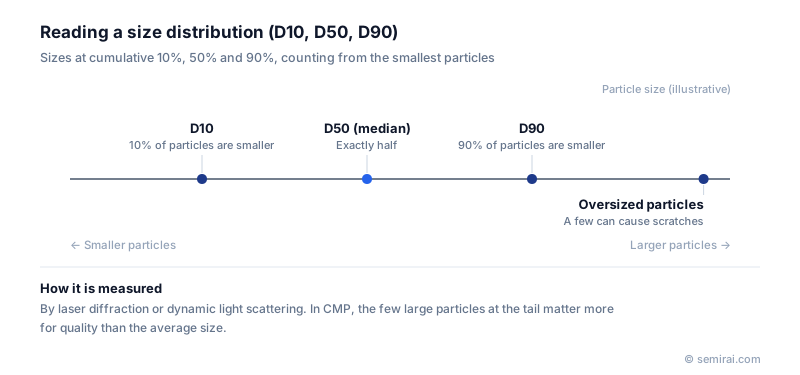
Particle size distribution describes what fraction of a population of particles falls into each size range. Because real particles are never all the same size, it captures not just the average but also the spread and the small number of very large particles. It is usually summarised by the sizes at cumulative 10%, 50% and 90% (D10, D50, D90).
Also called: PSD, D10, D50, D90
Diagram
How it is expressed and measured
Counting from the smallest particles, D10, D50 and D90 are the sizes below which 10%, 50% and 90% of the particles lie. D50 is the median diameter and is used as the representative size. A narrow gap between D10 and D90 means the particles are uniform.
Results differ greatly depending on whether the distribution is weighted by number or by volume: a few large particles are a small fraction by number but a large fraction by volume. Common methods include laser diffraction, which infers size from the pattern of scattered laser light; dynamic light scattering, which uses fluctuations caused by Brownian motion and suits nanoparticles; and single-particle counting.
Why it matters in semiconductors
For CMP slurries, the mean abrasive size affects removal rate and the spread affects uniformity, but rare large particles and agglomerates cause deep scratches. Slurry specifications therefore limit the count of particles above a threshold size, and filters remove them at the point of use.
In packaging, the silica filler in mould compounds is designed with a mix of sizes so it packs densely and lowers thermal expansion.
Japanese companies involved
- HORIBA and Shimadzu make particle size analysers, including laser diffraction instruments.
- Fujimi Incorporated and Resonac supply CMP slurries whose abrasive size distribution is a key specification.
- HORIBA · Mass flow controllers and process monitoring instruments
- Shimadzu · Analytical instruments
- Fujimi Incorporated · CMP slurries and polishing materials
- Resonac · CMP slurries, packaging materials and SiC epitaxial wafers
FAQ
What is D50?
It is the particle size at which half the particles are smaller and half are larger, also called the median diameter. Together with D10 and D90 it shows both the typical size and how widely sizes are spread.
Can laser diffraction detect the rare large particles that cause scratches?
Not reliably. Ensemble methods like laser diffraction report the overall distribution and can miss a tiny number of oversized particles. Single-particle optical counters are used alongside them to count large particles directly.
Related pages
- Abrasive
- Colloidal Silica
- CMP Slurry
- Epoxy Molding Compound (EMC)
- Zeta Potential
- Fumed Silica
- Encapsulants and coating materials
- Resonac HS-8 series ceria slurry (high-selectivity polishing)
- JSR CMP slurries (colloidal silica and Ru)
- Shin-Etsu Chemical Epoxy molding compound (KMC series)
- Shin-Etsu Chemical Liquid epoxy encapsulant (SMC series)
Sources
Last updated: November 12, 2026