Glazing (Pad and Wheel)
Glazing is the smoothing of a polishing pad or grinding wheel surface during use, which reduces its ability to remove material. The name comes from the glassy shine the worn surface takes on. In CMP it shows up as a falling removal rate; in grinding, as a loss of cutting sharpness.
Also called: pad glazing, loading
Diagram
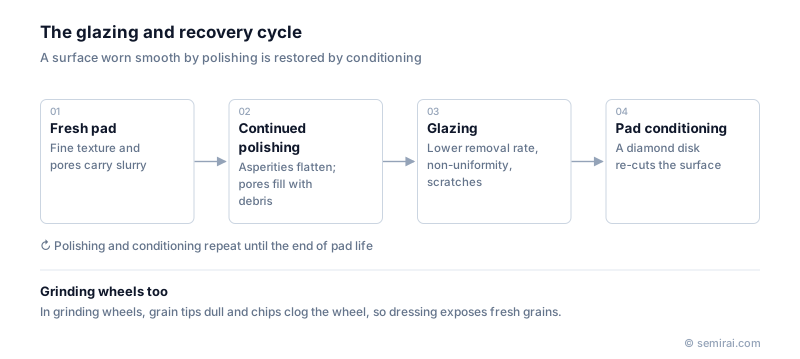
What happens to a CMP pad
A fresh CMP pad has fine surface roughness and many small pores. The high points (asperities) contact the wafer and do the polishing, while the pores hold and carry slurry. As polishing continues, the asperities are flattened and the pores fill with polishing debris and hardened slurry.
Slurry then cannot reach the gap between pad and wafer properly. Removal rate falls, non-uniformity across the wafer grows because different parts of the pad age differently, and trapped debris can cause scratches.
Restoring the surface
The remedy is pad conditioning: a disk set with diamond grit, the pad conditioner, cuts the pad surface lightly to recreate texture and open the pores. It can run at the same time as polishing (in-situ) or between wafers (ex-situ). Too much conditioning shortens pad life, so pressure, sweep and frequency are tuned while monitoring removal rate.
Grinding wheels show a similar problem: abrasive grain tips become dull and chips clog the wheel. Dressing removes the surface layer to expose fresh grains.
Japanese companies involved
- Asahi Diamond Industrial makes diamond CMP pad conditioners as well as grinding wheels.
- DISCO makes grinding wheels and grinders for wafer thinning, where wheel dressing is part of routine operation.
- Asahi Diamond Industrial · Dicing blades, grinding wheels and CMP pad conditioners
- DISCO · Dicing, grinding and polishing equipment
FAQ
How does glazing affect CMP results?
Removal rate drops because slurry is no longer carried to the wafer, uniformity worsens as pad condition varies across its surface, and debris packed into the pad can scratch the wafer. Fabs watch removal rate trends to catch glazing early.
What is the difference between glazing and loading?
In grinding, glazing usually means the abrasive grains have worn flat and dull, while loading means chips have clogged the spaces between grains. Both reduce cutting ability and both are corrected by dressing. In CMP pads the two effects tend to occur together.
Related pages
Sources
Last updated: November 13, 2026