Ceria Slurry
Ceria slurry is a CMP polishing liquid that uses fine cerium oxide (CeO₂, ceria) particles as the abrasive. Whereas silica abrasives act mainly mechanically, ceria bonds chemically with the surface of silicon oxide and pulls material away, so it removes oxide quickly even with a small amount of abrasive.
Also called: cerium oxide slurry, CeO₂ slurry
Diagram
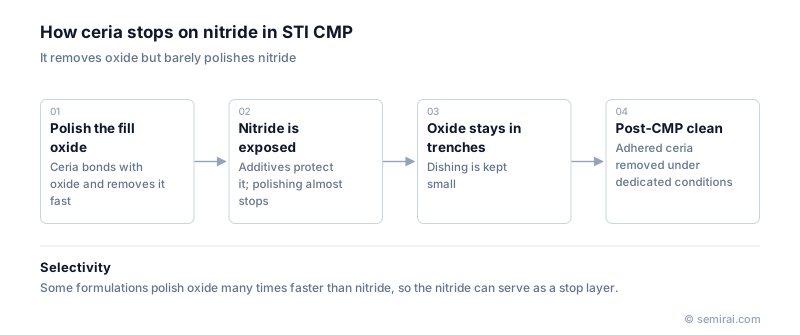
Selective polishing in STI
The best-known application is shallow trench isolation (STI) CMP. With suitable additives, ceria slurry polishes oxide quickly while barely touching the silicon nitride (Si₃N₄) underneath. When the nitride is exposed, polishing effectively stops on its own, which keeps thickness variation and dishing small.
This high oxide-to-nitride selectivity lets the nitride serve as a stop layer. Ceria slurries are also used for other oxide planarisation steps where high removal rate at low abrasive loading is useful.
The additives are what make the selectivity. Molecules that adsorb on the nitride surface, or on low-lying areas, shield them from the ceria particles, while raised oxide stays exposed. Tuning the additive package and pH lets slurry makers set how strongly polishing slows once the nitride appears and how it treats areas of different pattern density.
Challenges: residue and scratches
The chemical bonding that makes ceria effective also makes particles cling to the oxide surface, and they are hard to remove with standard cleaning. Post-CMP cleaning for ceria therefore needs dedicated chemistries and conditions.
Coarse particles can cause scratches. Suppliers have developed smaller, more uniform ceria particles and formulations with less abrasive to reduce defects while keeping removal rate.
Japanese companies involved
- Resonac supplies ceria slurries for high-selectivity polishing, including nano-ceria products for front-end processes.
- Fujimi Incorporated supplies CMP slurries for a range of front-end and interconnect applications.
- Resonac · CMP slurries, packaging materials and SiC epitaxial wafers
- Fujimi Incorporated · CMP slurries and polishing materials
FAQ
Why does ceria polish oxide so fast?
The surface of ceria particles is thought to bond chemically with silicon at the oxide surface and tear atoms away, a mechanism sometimes called the chemical tooth. Because it does not rely only on rubbing, high removal rates are possible with little abrasive.
Why is cleaning after ceria CMP difficult?
The same chemical bond that drives polishing holds the particles tightly to the oxide. A standard SC1 clean often does not remove them fully, so processes use reducing chemistries, combined brush scrubbing or other dedicated conditions.
Related pages
Sources
Last updated: November 12, 2026