Hydrophilicity and Hydrophobicity
Hydrophilicity is the tendency of a surface to be wetted by water, so that water spreads thinly; hydrophobicity is the tendency to repel water, so that droplets bead up. It is expressed by the contact angle between a droplet's edge and the surface: the smaller the angle, the more hydrophilic the surface.
Also called: wettability, water contact angle
Diagram
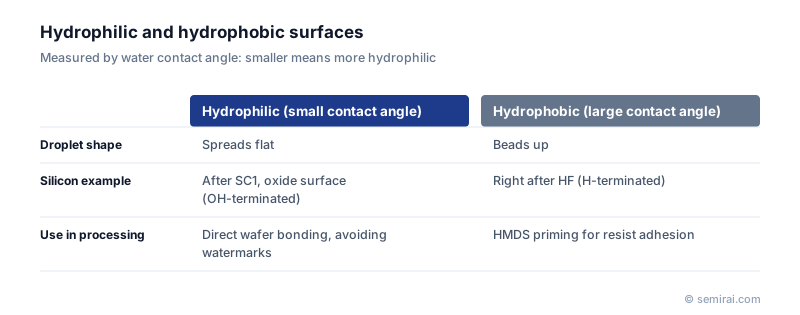
Contact angle and silicon surfaces
As a rule of thumb, a contact angle below 90° is called hydrophilic and above 90° hydrophobic; a surface where water spreads almost flat, below about 10°, is called superhydrophilic. The thresholds vary somewhat between fields.
A silicon wafer can switch between the two states. Right after dilute hydrofluoric acid (DHF) removes the native oxide, the surface is terminated with hydrogen and repels water. Engineers use this as a quick check: if water runs off the wafer as it is lifted out, the oxide is gone. Surfaces treated with SC1 or ozonated water, and oxide surfaces in general, carry hydroxyl (-OH) groups and are hydrophilic. Hydrophobic surfaces leave droplets behind that can dry into watermarks, which affects the choice of drying method.
Where surface wetting is used
HMDS priming before resist coating makes the surface hydrophobic to improve resist adhesion. Direct wafer bonding makes surfaces hydrophilic so that hydroxyl groups on the two wafers can bond. In immersion lithography the top layer over the resist is made hydrophobic so that water does not stay on the fast-moving wafer.
Contact angle is measured with a goniometer. Because even a trace of organic contamination changes the angle, it also serves as a simple indicator of surface cleanliness.
Japanese companies involved
- SCREEN Holdings and Tokyo Electron build wafer cleaning and drying systems, where control of the surface state before drying is part of the process.
- SCREEN Holdings · Wafer cleaning, coat/develop and inspection equipment
- Tokyo Electron (TEL) · Coat/develop, etch and deposition equipment
FAQ
Why does HF-treated silicon repel water?
Removing the oxide leaves silicon atoms bonded to hydrogen at the surface. These Si-H bonds do not form hydrogen bonds with water the way hydroxyl groups do, so water beads up and runs off.
What contact angle counts as superhydrophobic?
Surfaces with a water contact angle of about 150° or more, where droplets are almost spherical, are usually called superhydrophobic. Such surfaces rely on fine surface texture as well as chemistry and are not typical of wafer surfaces.
Related pages
Sources
Last updated: November 2, 2026