Ionisation
Ionisation is the process of turning an atom or molecule into an electrically charged ion, usually by removing an electron and sometimes by adding one. In semiconductor manufacturing it is the starting point for creating processing plasmas, for producing dopant ions in ion implantation, and for analytical methods such as mass spectrometry.
Also called: ionization, electron-impact ionisation
Diagram
Ionisation in a plasma
In a processing plasma, electrons accelerated by the electric field collide with gas molecules and knock out further electrons. This electron-impact ionisation is the main mechanism that sustains the discharge.
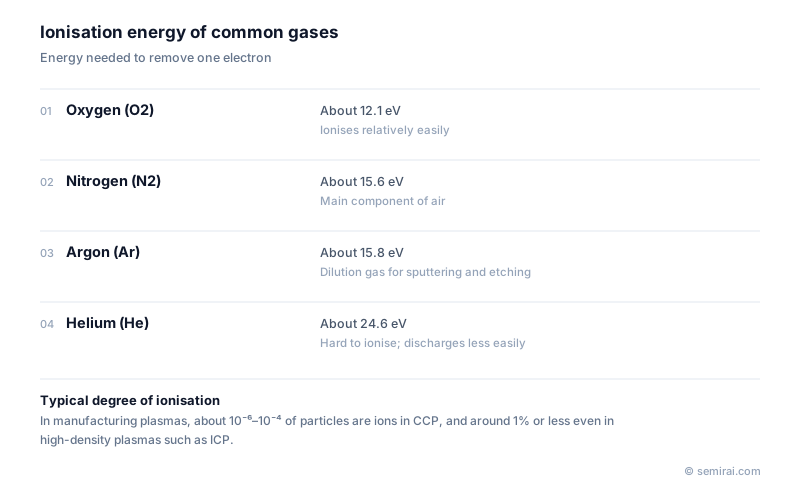
The minimum energy needed to remove one electron, the ionisation energy, depends on the gas: about 12.1 eV for molecular oxygen, 15.6 eV for nitrogen, 15.8 eV for argon and 24.6 eV for helium. Gases with high ionisation energy, such as helium, are harder to ignite and sustain as a discharge.
How much of a plasma is ionised
Only a small fraction of the particles in a manufacturing plasma are ions. The degree of ionisation is about 10⁻⁶ to 10⁻⁴ in capacitively coupled plasma and around 1% or less even in high-density sources such as inductively coupled plasma. Most of the gas remains neutral molecules and radicals.
The roles are divided. The few ions, accelerated by the sheath field, provide directional processing, while the far more numerous radicals carry out most of the surface chemistry. In ion implanter ion sources and in analytical instruments such as secondary ion mass spectrometry (SIMS), how efficiently the target species can be ionised is a key measure of performance.
Japanese companies involved
- Nissin Ion Equipment and Sumitomo Heavy Industries Material Solutions make ion implanters, whose ion sources ionise dopant gases such as boron, phosphorus and arsenic compounds.
- Nissin Ion Equipment · Ion implanters
- Sumitomo Heavy Industries Material Solutions (formerly SMIT) · Ion implanters
- Tokyo Electron (TEL) · Coat/develop, etch and deposition equipment
FAQ
Why is argon so widely used in plasmas?
Argon is chemically inert, relatively cheap and has a moderate ionisation energy, so it ignites easily and gives a stable discharge. Its heavy ions are also effective for physical sputtering. It is used as a dilution gas in etching and as the working gas in sputter deposition.
Can ionisation happen without electron collisions?
Yes. Molecules can also be ionised by light with enough photon energy, by collisions with excited atoms (Penning ionisation) or by strong fields. In processing plasmas, however, electron impact is by far the dominant mechanism.
Related pages
- Plasma (Semiconductor Processing)
- Dissociation
- ICP (Inductively Coupled Plasma)
- Ion Implantation
- Secondary Ion Mass Spectrometry (SIMS)
- DC Discharge (Glow Discharge)
- Ionization Gauge
- Thomson Scattering
- Dry etching equipment
- Tokyo Electron (TEL) Acrevia™
- Tokyo Electron (TEL) Tactras™
- Elionix EIS-200ERP
- Panasonic Connect APX300-DM
Sources
Last updated: November 13, 2026