Langmuir Probe
A Langmuir probe is a small metal electrode inserted into a plasma. Sweeping the voltage applied to it and measuring the current that flows gives the electron density, the electron temperature and the plasma potential. Devised by the American chemist Irving Langmuir in the 1920s, it is the most basic tool of plasma diagnostics.
Also called: electrostatic probe, single probe
Diagram
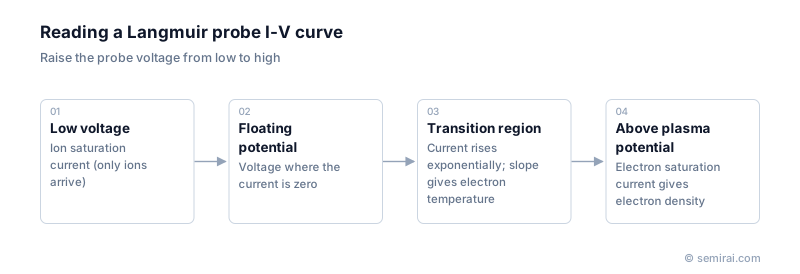
Reading the current-voltage curve
At strongly negative probe voltage, electrons are repelled and only ions are collected; this is the ion saturation current. As the voltage rises, electrons with enough energy to overcome the repulsion begin to arrive, starting with the fastest, and the current rises exponentially. The slope of this transition region on a logarithmic scale gives the electron temperature.
The voltage at which the net current is zero is the floating potential. At the plasma potential the curve bends, and above it all electrons reach the probe, giving the electron saturation current. Electron density is calculated from the electron or ion saturation current together with the electron temperature. With further analysis the electron energy distribution can also be obtained.
Strengths and weaknesses
The probe is simple and can be moved to map values at different positions in a chamber. However, it disturbs the plasma it measures, and in etching gases its surface becomes coated with films that distort the readings. In plasmas driven by RF power, the plasma potential oscillates at the drive frequency, so RF compensation is needed to obtain an accurate curve.
For these reasons production tools rely mainly on non-contact methods such as optical emission spectroscopy, while Langmuir probes are used in research and equipment development.
Japanese companies involved
- HORIBA · Mass flow controllers and process monitoring instruments
FAQ
What can a Langmuir probe measure?
Mainly electron density, electron temperature, plasma potential and floating potential, and with careful analysis the electron energy distribution. Moving the probe through the chamber maps these values in space, which is useful when developing new plasma sources.
Why is it rarely used on production tools?
Inserting a metal electrode can disturb the plasma and introduce contamination, and etch gases coat the probe so that its readings drift. Production monitoring therefore uses non-contact methods such as emission spectroscopy through a chamber window.
Related pages
Sources
Last updated: November 13, 2026