Thomson Scattering
Thomson scattering is the scattering of light by free electrons. In laser Thomson scattering, a laser beam is sent into a plasma and the light scattered by its electrons is analysed to find the electron density and electron temperature. Nothing has to be inserted into the plasma, so the measurement does not disturb it.
Also called: laser Thomson scattering, LTS
Diagram
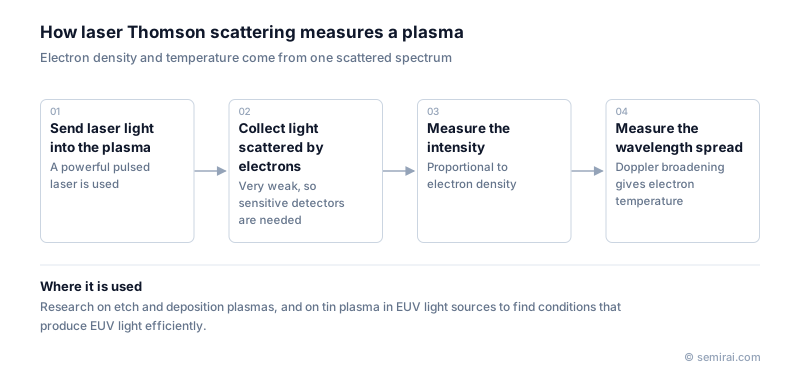
How the measurement works
The intensity of the scattered light is proportional to the number of electrons in the measured volume, which gives electron density. The scattered light is also spread in wavelength by the Doppler effect, because each electron is moving. The faster the electrons, the wider the spread, so the width of the spectrum gives electron temperature.
Both quantities come from a single spectrum at one point in space. Unlike a Langmuir probe, which inserts a metal electrode, the method works in reactive gases that would coat a probe, and it does not perturb the plasma.
Limits and uses
Scattering by electrons is extremely weak. The method needs a powerful pulsed laser, sensitive detectors and careful rejection of stray laser light and of much stronger scattering by gas molecules. The apparatus is large and expensive, so it is used mainly in research and development rather than on production tools.
In the semiconductor field it is used to understand etching and deposition plasmas and to check plasma simulations. It has also been applied to the laser-produced tin plasma in EUV lithography light sources, where measuring electron density and temperature helps identify conditions that produce EUV light efficiently.
Japanese companies involved
- Gigaphoton develops laser-produced tin plasma EUV light sources, an application in which plasma diagnostics such as Thomson scattering are used to study how efficiently EUV light is generated.
- Gigaphoton · Excimer laser light sources for lithography
FAQ
Why does Thomson scattering reveal electron temperature?
Moving electrons shift the wavelength of the light they scatter by the Doppler effect. Hotter electrons have a wider spread of speeds, so the scattered spectrum is broader. Fitting the width of the spectrum gives the electron temperature.
How does it compare with a Langmuir probe?
A Langmuir probe is simple and cheap but disturbs the plasma and can be coated by reactive gases, which distorts the reading. Thomson scattering avoids both problems, but needs a large optical setup and gives a weak signal, so it is reserved for research and calibration.
Related pages
Sources
Last updated: November 13, 2026