Self-bias (DC Self-bias)
Self-bias is the negative DC voltage that develops by itself on an electrode or wafer when a plasma is driven with RF power. Its value is written Vdc. No external DC supply is needed: the negative potential forms naturally on the RF electrode and accelerates positive ions from the plasma into the wafer resting on it.
Also called: DC self-bias, Vdc, self-bias voltage
Diagram
Why the voltage appears
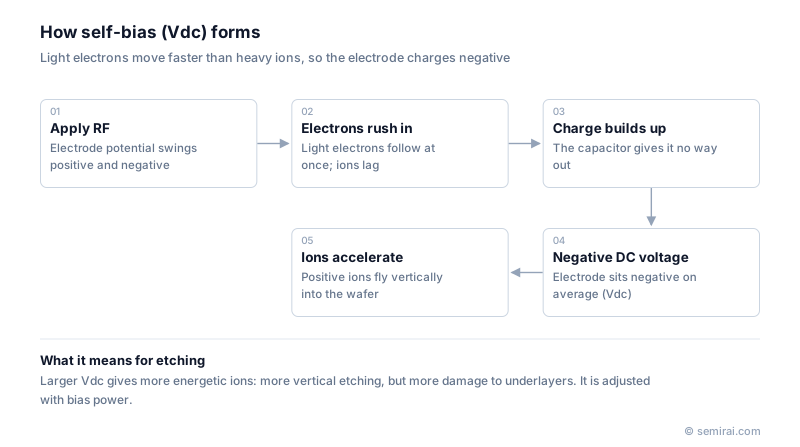
The RF electrode is connected to the power supply through a blocking capacitor, which passes RF but not DC. During the short part of each RF cycle when the electrode is positive, many light, fast electrons flow in. During the negative part, only a small current of heavy, slow ions arrives. Because no DC current can flow, negative charge accumulates until the electron and ion currents balance over a cycle, and the electrode settles at a negative average potential.
In a parallel-plate (CCP) system the smaller electrode develops the larger self-bias. Placing the wafer on an electrode smaller than the grounded chamber walls therefore directs ion bombardment efficiently onto the wafer.
Why it matters in etching
The energy of ions reaching the wafer is roughly the difference between the plasma potential and the self-bias. It governs the anisotropy and etch rate of reactive ion etching (RIE) and the damage done to underlying layers.
In a parallel-plate system, raising RF power changes plasma density and self-bias together. ICP and other high-density sources separate the supply that creates the plasma from the bias supply on the wafer side, so density and ion energy can be set independently. Vdc is monitored continuously on production tools, and drifts in its value can reveal changes in chamber wall condition or wear of parts.
Japanese companies involved
- Tokyo Electron (TEL) etch systems use RF bias on the wafer electrode to control ion energy, the quantity that self-bias represents.
- Tokyo Electron (TEL) · Coat/develop, etch and deposition equipment
FAQ
Is self-bias the same as the sheath voltage?
Not exactly. Ions gain energy across the sheath, whose voltage is the plasma potential minus the electrode potential. Since the plasma potential is usually small and positive, the sheath voltage is a little larger than the magnitude of Vdc, but the two move together.
Why can't self-bias form on a DC-grounded electrode?
Without the blocking capacitor, the excess electron current would simply flow away to the supply or ground, and no net negative charge could build up. The capacitor, or an insulating wafer and chuck, is what allows the charge to accumulate.
Related pages
- Plasma Sheath
- RIE (Reactive Ion Etching)
- CCP (Capacitively Coupled Plasma)
- ICP (Inductively Coupled Plasma)
- RF Generator
- Plasma (Semiconductor Processing)
- Electrostatic Chuck (ESC)
- DC Discharge (Glow Discharge)
- Dry etching equipment
- Tokyo Electron (TEL) Acrevia™
- Tokyo Electron (TEL) Tactras™
- Daihen RF generators and auto matching units (RGA/WGA/MGA/FGA series)
- Elionix EIS-200ERP
Sources
Last updated: November 13, 2026