In-situ
In-situ, Latin for "in place", describes measurement or processing done inside a process tool without removing the wafer. In chipmaking it covers monitoring a wafer while it is being etched, deposited or polished, adding dopants during film growth, and running several steps in sequence without breaking vacuum. The opposite is ex-situ.
Also called: in situ, in-situ monitoring, in-situ doping
Diagram
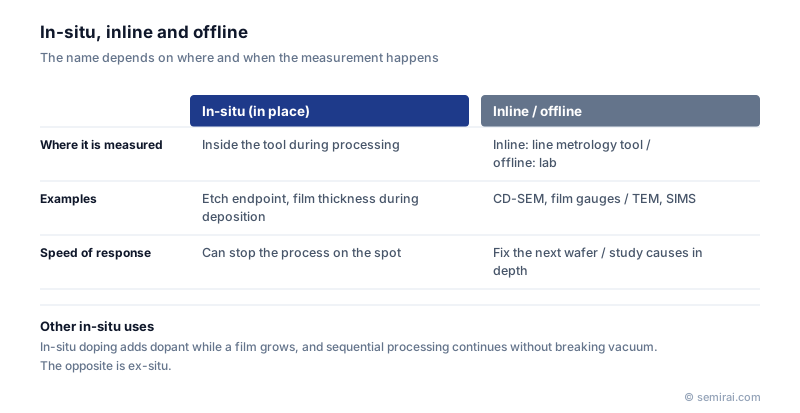
Three common uses
In-situ monitoring follows the process as it runs. Optical emission spectroscopy watches the plasma during etching and detects the moment an underlying layer is exposed, which is called endpoint detection. Ellipsometry or interferometry can track film thickness during deposition, and optical or eddy-current sensors track remaining thickness during chemical mechanical planarization (CMP). Stopping each wafer at the right moment reduces wafer-to-wafer variation.
In-situ doping adds a dopant gas while an epitaxial or polysilicon film grows, so the film is doped as it forms and no separate implant or diffusion step is needed. In-situ cleaning and sequential processing keep a wafer under vacuum from pre-clean to deposition, preventing native oxide growth and contamination that exposure to air would cause.
Strengths and limits
In-situ measurement saves the time of moving wafers to a separate tool and allows correction during the process itself, not just on the next wafer. The difficulty is the environment: plasma, heat and corrosive gases cloud viewing windows and age sensors, and only some properties can be measured this way.
For this reason in-situ signals are usually compared with inline measurements and fed into advanced process control and virtual metrology models, rather than trusted on their own.
Japanese companies involved
- HORIBA makes process monitoring instruments, including plasma emission endpoint monitors and gas analysers used for in-situ monitoring of etch and deposition.
- Tokyo Electron builds etch and deposition systems that include in-situ sensors and multi-chamber configurations for processing without breaking vacuum.
- HORIBA · Mass flow controllers and process monitoring instruments
- Tokyo Electron (TEL) · Coat/develop, etch and deposition equipment
FAQ
How is in-situ different from inline?
Inline measurement uses a separate metrology tool in the production line after a step is finished. In-situ measurement happens inside the process tool while the wafer is still being processed, so it can be used to stop or adjust that very step.
How is in-situ pronounced?
In English it is usually said "in SIT-yoo" or "in SY-tyoo". It is often written without the hyphen, as in situ, especially in scientific papers.
Related pages
Sources
Last updated: November 2, 2026