Mean Free Path
The mean free path is the average distance a gas molecule or plasma particle travels between one collision and the next. It is inversely proportional to pressure, so it lengthens as pressure falls. In chipmaking it is a basic yardstick for choosing pressure in sputtering, etching and CVD, and a way to describe the quality of a vacuum.
Also called: MFP
Diagram
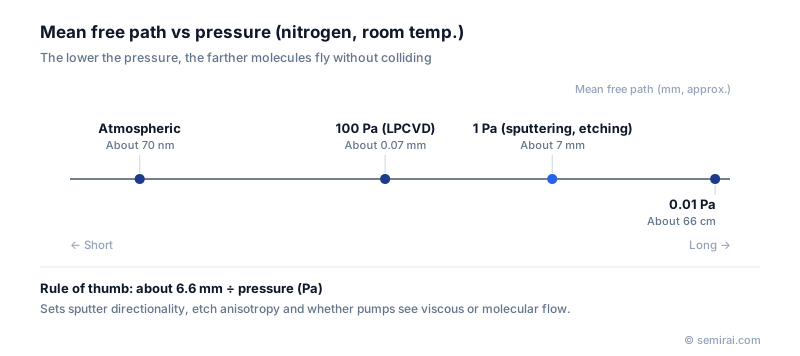
How it depends on pressure
Mean free path is proportional to temperature and inversely proportional to pressure and to the collision cross-section of the molecules. For nitrogen or air at room temperature, a handy estimate is mean free path in millimetres ≈ 6.6 divided by pressure in pascals.
That gives about 70 nm at atmospheric pressure (about 100,000 Pa), about 7 mm at 1 Pa and about 7 m at 10⁻³ Pa. The ratio of mean free path to a characteristic size of the chamber or pipe, the Knudsen number, tells how the gas flows. When the path is much shorter than the vessel, collisions between molecules dominate (viscous flow). When it is much longer, molecules mostly hit the walls (molecular flow). Turbomolecular pumps are designed to work in the molecular flow regime.
Effects on processes
In sputtering, lowering pressure lengthens the mean free path so atoms leaving the target travel in straight lines without scattering and reach the bottom of deep holes more easily. In dry etching, ions crossing the plasma sheath without collisions strike the wafer at right angles and give anisotropic profiles. CVD often uses higher pressure deliberately, relying on gas-phase collisions to coat the sidewalls of features evenly.
The term is also used for electrons in solids, meaning the average distance before scattering by lattice vibrations, impurities or surfaces. When copper interconnects become narrower than the electron mean free path, their resistivity rises, a size effect that matters at advanced nodes.
Japanese companies involved
- ULVAC makes sputtering systems and vacuum pumps, and Ebara makes dry vacuum pumps, both working in the pressure ranges described here.
FAQ
What pressures are used in sputtering and dry etching?
Most run between about 0.1 Pa and a few tens of pascals. In that range the mean free path ranges from roughly the size of the chamber down to fractions of a millimetre, so engineers can trade directionality against deposition or etch rate by adjusting pressure.
Why does copper wiring resistance rise at small widths?
The electron mean free path in copper is a few tens of nanometres. When a wire is about that narrow, electrons scatter more often from its surfaces and grain boundaries, so resistivity climbs above the bulk value. This is one reason alternative metals are studied for the finest wiring levels.
Related pages
Sources
Last updated: November 13, 2026