LOCOS (Local Oxidation of Silicon)
LOCOS (local oxidation of silicon) is a device isolation method that thermally oxidises only selected areas of a silicon wafer, growing a thick oxide that electrically separates neighbouring transistors. Researchers at Philips in the Netherlands published it around 1970, and for more than two decades it was the standard isolation technique for integrated circuits.
Also called: local oxidation, selective oxidation
Diagram
Process flow
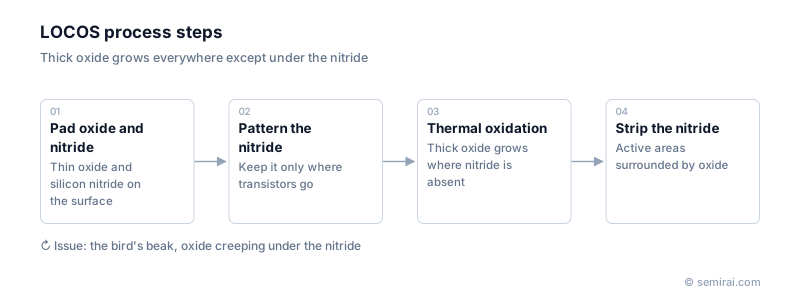
A thin pad oxide and a silicon nitride film are deposited on the wafer, and the nitride is patterned so that it remains only where transistors will be built. Silicon nitride blocks oxygen, so when the wafer is oxidised at high temperature in oxygen or steam, thick oxide grows only where the nitride has been removed.
The nitride is then stripped, leaving each active area surrounded by thick field oxide. The pad oxide underneath the nitride reduces stress between the nitride and the silicon.
The bird's beak and the move to STI
Oxygen also diffuses sideways under the edge of the nitride, so the oxide extends inward in a tapering wedge that looks like a bird's beak in cross-section. The beak eats into the active area and widens the space needed between devices.
As transistors shrank, this loss became too large. From around the 0.25 µm generation, LOCOS was replaced by shallow trench isolation (STI), in which trenches are etched into the silicon, filled with oxide and planarised. LOCOS is still used in older process generations, power semiconductors and some analog ICs.
Japanese companies involved
- Kokusai Electric and Tokyo Electron make the batch oxidation and diffusion furnaces in which field oxides are grown.
- Kokusai Electric · Batch deposition, diffusion and ALD equipment
- Tokyo Electron (TEL) · Coat/develop, etch and deposition equipment
FAQ
How does LOCOS differ from STI?
LOCOS grows oxide by consuming the silicon surface, which creates a bird's beak and an uneven surface. STI etches a shallow trench, fills it with deposited oxide and polishes it flat with CMP. STI has no bird's beak, allows tighter spacing and leaves a flatter surface for later lithography.
Why is LOCOS still used in power devices?
Power and analog processes use larger dimensions, so the area lost to the bird's beak matters less. LOCOS needs no trench etch or CMP, which keeps the process simple and mature, and its thick oxide also works as field plates and high-voltage isolation.
Related pages
- Shallow Trench Isolation (STI)
- FEOL / BEOL (Front-End of Line / Back-End of Line)
- Oxide Film (Silicon Dioxide)
- CMOS (Complementary Metal-Oxide-Semiconductor)
- Power Semiconductor
- Oxidation furnaces
- Kokusai Electric VERTEX Revolution
- EpiQuest VOX6001 / HiVOX6001
- Koyo Thermo Systems (JTEKT Thermo Systems) VF-3000
- Koyo Thermo Systems (JTEKT Thermo Systems) VF-3000B
Sources
Last updated: November 13, 2026