Diode
A diode is the most basic semiconductor device: it lets current flow in only one direction, a property called rectification. Its basic structure is a pn junction joining p-type and n-type material. Current flows from the anode (p side) to the cathode (n side), but almost none flows the other way.
Also called: pn junction diode, rectifier
Diagram
How a pn junction diode behaves
Where p-type and n-type regions meet, electrons and holes diffuse across the junction and recombine, leaving a depletion region with a built-in electric field. Applying a forward voltage reduces this barrier. Once the voltage exceeds roughly 0.6 to 0.7 V for silicon, current rises steeply. Under reverse voltage the barrier grows and only a tiny leakage current flows.
If the reverse voltage is raised too far, the junction breaks down and current increases suddenly. Ordinary diodes must be kept below this breakdown voltage, while Zener diodes are designed to operate in it.
Types and uses
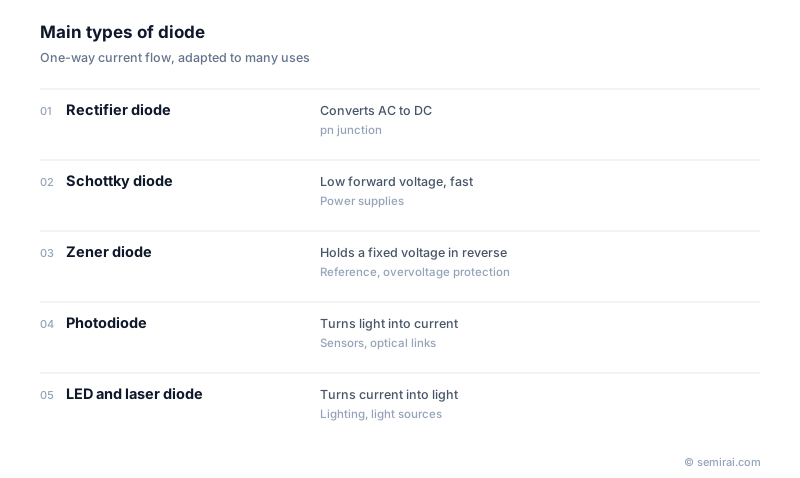
Rectifier diodes convert alternating current to direct current in power supplies. Schottky barrier diodes use a metal-semiconductor junction for a lower forward voltage and faster switching. Zener diodes hold a fixed voltage in reverse and are used for reference voltages and overvoltage protection. Photodiodes turn light into current, while light-emitting diodes (LEDs) and laser diodes turn current into light.
Diodes also protect circuits against reverse polarity and electrostatic discharge, clamp voltages, and detect radio signals. Fast-recovery and SiC diodes are paired with transistors in inverters and switching power supplies, where switching losses matter.
Japanese companies involved
- ROHM makes a wide range of diodes, from small-signal and Zener diodes to Schottky barrier diodes and SiC diodes for power applications.
- Toshiba Electronic Devices & Storage also makes small-signal, Schottky and Zener diodes.
- Toshiba Electronic Devices & Storage · Power MOSFETs, IGBTs and discrete semiconductors
- ROHM · SiC and silicon power devices, analog ICs
FAQ
Why is the forward voltage about 0.6 to 0.7 V in silicon?
Current must overcome the built-in barrier of the junction, which depends on the band gap and doping. For silicon at room temperature, the current becomes useful at around 0.6 to 0.7 V. Germanium diodes start lower and Schottky diodes lower still.
What is reverse recovery?
When a pn diode switches from forward to reverse, the minority carriers stored in it must be removed first, so a short reverse current flows. This reverse recovery causes losses at high switching frequency, which is why fast-recovery and Schottky diodes exist.
How do I tell the anode from the cathode?
On most packaged diodes the cathode is marked by a band or stripe. In the circuit symbol, the arrow points from anode to cathode, in the direction of conventional current flow.
Related pages
Sources
Last updated: November 2, 2026