Leakage Current
Leakage current is current that flows in a semiconductor device through a path that should ideally carry none, such as between source and drain of a transistor that is switched off, or through an insulating film. In advanced chips it accounts for most of the power consumed while circuits are idle, and controlling it is a central goal of transistor design.
Also called: leakage, off-state current, standby current
Diagram
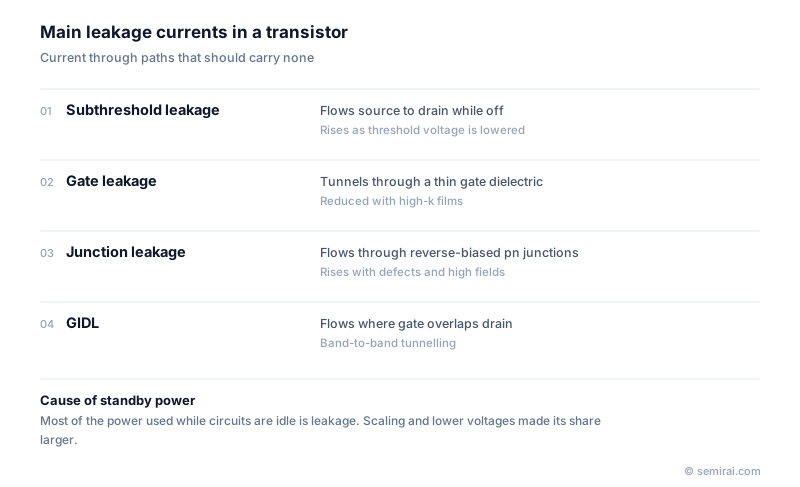
The main leakage mechanisms
Subthreshold leakage flows between source and drain when the gate voltage is below the threshold voltage. It falls exponentially with the gap between gate voltage and threshold, so every reduction in threshold voltage made to gain speed raises it steeply. Short-channel effects such as drain-induced barrier lowering make it worse.
Gate leakage is quantum-mechanical tunnelling of carriers through the gate dielectric. It grows exponentially as the dielectric gets thinner, and became serious when silicon dioxide gates approached a few atomic layers. Junction leakage flows across reverse-biased pn junctions at the source and drain, increasing with defects and high electric fields. Gate-induced drain leakage (GIDL) comes from band-to-band tunnelling where the gate overlaps the drain.
How the industry reduces leakage
Each mechanism has its own remedy. Replacing silicon dioxide with a high-k dielectric allowed a physically thicker gate insulator with the same electrical effect, cutting gate leakage sharply. FinFET and gate-all-around structures surround the channel with the gate, suppressing subthreshold leakage in short channels. Careful junction engineering and annealing reduce junction leakage and GIDL.
At circuit level, designers use high-threshold transistors where speed is not needed, turn off the power to idle blocks (power gating) and adjust the body bias. In DRAM, leakage determines how long a cell holds its charge, and therefore how often it must be refreshed. Leakage also rises strongly with temperature, so it affects battery life in phones and cooling costs in data centres.
FAQ
Why did leakage become a problem only in recent decades?
Older transistors had thick gate oxides and high threshold voltages, so leakage was negligible. Scaling lowered both to keep speed up at lower supply voltages, and from about the 90 nm generation static leakage power became a large fraction of total chip power.
How is leakage current measured?
On a wafer, parametric testers measure the off-state drain current of test transistors and the current through gate and junction test structures. For finished chips, standby supply current (IDDQ) is measured; an abnormally high value can also reveal manufacturing defects.
Does leakage matter outside logic chips?
Yes. In power devices leakage under high reverse voltage affects losses and reliability, in image sensors dark current is a form of leakage that adds noise, and in capacitors and insulating films leakage indicates degradation.
Related pages
Sources
Last updated: November 2, 2026