Parametric Test (DC Test)
A parametric test, also called a DC test, measures electrical parameters of a semiconductor chip, such as leakage current, output voltage and supply current, and checks numerically that each one falls within the specification. It complements functional testing, which only checks whether outputs match expected 0s and 1s.
Also called: DC parametric test, DC test
Diagram
How it is measured
In automatic test equipment (ATE), a parametric measurement unit (PMU) connected to each pin either forces a voltage and measures the resulting current, or forces a current and measures the voltage. The measured analogue value is compared with an upper and a lower limit, so the result is a number rather than a simple match or mismatch.
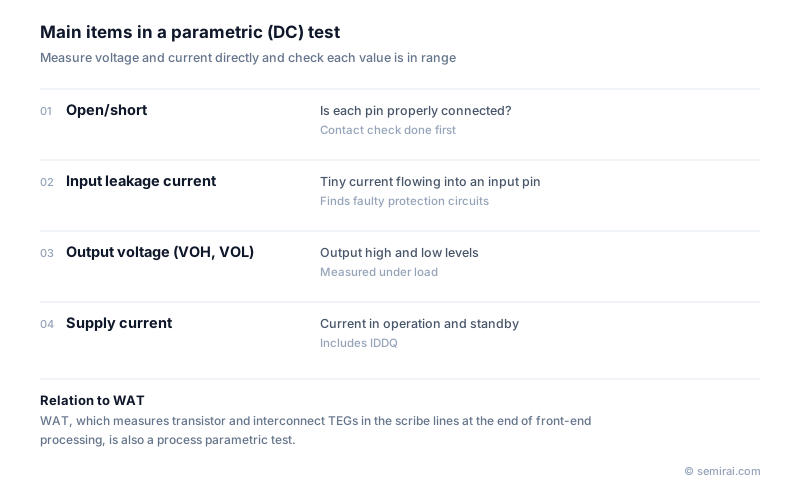
Typical product tests include the contact test (open/short), which passes a small current through each pin's protection diode to find poor contact with the probe or socket and shorts between pins; it usually runs first in the test flow. Then come input leakage current, output high and low voltages (VOH and VOL) under a defined load current, and supply current in standby and in operation. IDDQ testing is a special case of the supply-current measurement.
Process parametric test on the wafer
A separate kind of parametric test is run at the end of front-end processing. It measures test element groups (TEGs), small test structures usually placed in the scribe lines, and is called WAT (wafer acceptance test) or PCM (process control monitor). It records transistor threshold voltage and drive current, line and via resistance, sheet resistance and similar values to decide whether the wafer met the process specification. The goal is to confirm that the process was healthy, not to judge individual products.
Using the data beyond pass or fail
Parametric results also feed quality control. A chip whose leakage is slightly higher than its neighbours may pass today yet hide a latent defect, so automotive suppliers apply part average testing (PAT), which removes statistical outliers even when they are inside the limits. Matching WAT data against product test results also helps engineers find which process step caused a yield loss.
Japanese companies involved
- Advantest builds SoC and memory test systems whose per-pin PMUs and device power supplies perform these DC measurements.
- Tokyo Seimitsu (ACCRETECH) makes wafer probers that position wafers under the probe card for both product wafer test and WAT.
- TESEC makes testers for discrete and power semiconductors, where DC measurements such as leakage and on-voltage form most of the test.
- TESEC · Testers and handlers for discrete and power semiconductors
- Advantest · Automated test equipment (ATE) for SoC and memory
- Tokyo Seimitsu (ACCRETECH) · Wafer probers, dicing and grinding machines, metrology
FAQ
How does a parametric test differ from a functional test?
A functional test applies test patterns and checks that each output bit matches the expected value, which verifies the logic. A parametric test measures analogue quantities such as current and voltage against numeric limits. A chip can pass one and fail the other, so production flows use both before a part is shipped.
Why is the open/short test done first?
If a pin is not touching the probe or socket, every later measurement on that pin is meaningless. Checking contact first lets the tester stop early, re-seat the device or flag a probe problem instead of wasting test time and wrongly rejecting good chips.
Related pages
Sources
Last updated: November 13, 2026