IDDQ Test
An IDDQ test measures the supply current of a CMOS circuit in its quiescent state, when no inputs are switching, and rejects chips whose current is abnormally high. A healthy CMOS circuit draws only a tiny leakage current at rest, so defects that create a current path show up clearly as extra current.
Also called: quiescent supply current test, IDDQ testing
Diagram
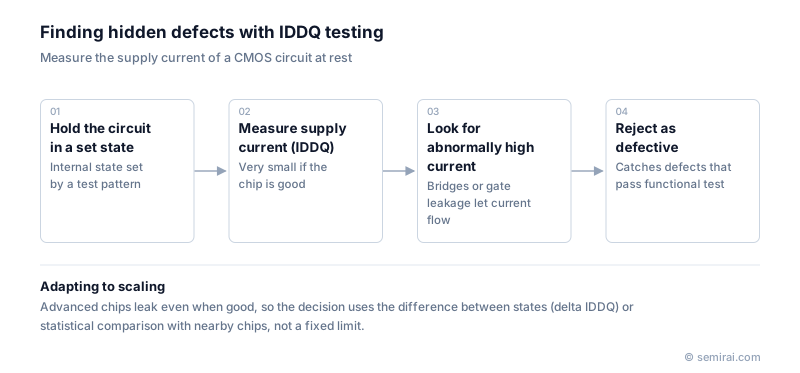
Why quiescent current reveals defects
In a static CMOS gate, either the PMOS or the NMOS transistor is always off once the inputs settle, so there is no direct path between the supply and ground. A bridging defect that joins two wires, a leaky gate oxide, or a transistor that never fully turns off creates such a path and raises IDDQ sharply.
These defects are easy to miss with functional tests and with stuck-at fault tests, because the logic value may still come out correct. As current, however, they appear with only a few measurements. Catching them reduces parts that later fail in the field, and IDDQ testing spread widely as a quality tool in the 1990s.
How the test is run
The tester applies part of a test pattern to put the circuit into a known internal state, waits for the current to settle, measures it, and repeats for the next state. A few to a few dozen states are typical. The settling time is the main weakness: adding more states lengthens test time much more than adding functional vectors does.
IDDQ at advanced nodes
Scaling made the method harder. Lower threshold voltages raised subthreshold leakage, so even good chips draw substantial current, and the extra current from a defect can disappear inside the normal chip-to-chip spread. Engineers therefore look at the difference in current between states (delta IDDQ) or compare each chip with its neighbours on the same wafer using statistics. With these refinements IDDQ remains an important screen for high-reliability products such as automotive chips.
Japanese companies involved
- Advantest's test systems include the precision power supplies and current measurement needed to run IDDQ and delta-IDDQ screens in production.
- Advantest · Automated test equipment (ATE) for SoC and memory
FAQ
What kinds of defects does IDDQ testing catch?
Mainly defects that open an unintended path between supply and ground: resistive bridges between lines, gate-oxide pinholes and leakage, and transistors that stay partly on. Many of these do not change the logic output at test time but can grow into hard failures later, so IDDQ is valued as a screen for latent defects.
Is IDDQ testing still used on modern chips?
Yes, though rarely with a single fixed current limit. Because normal leakage varies with process and temperature, modern flows use relative criteria such as current ratios between vectors, delta IDDQ or neighbourhood statistics, and they apply it most where reliability matters, for example in automotive parts.
Related pages
Sources
Last updated: November 13, 2026