Sulfur Hexafluoride (SF6)
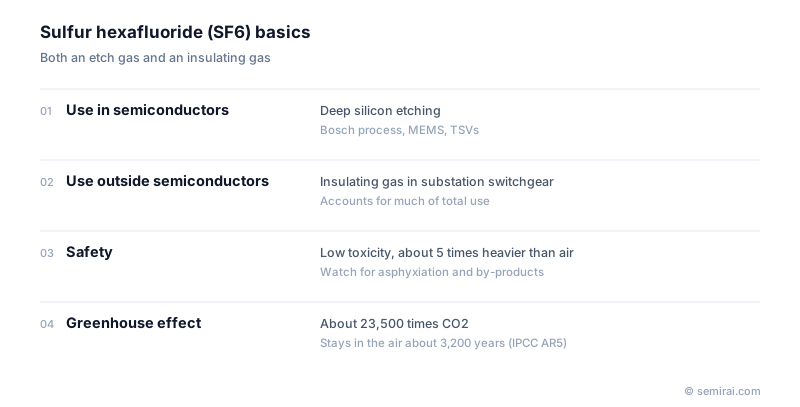
Sulfur hexafluoride (SF6) is a colourless, odourless gas of one sulphur atom bonded to six fluorine atoms, and it is chemically very stable. In semiconductor manufacturing it is the main etch gas for cutting deep into silicon, particularly in the Bosch process used to make MEMS and through-silicon vias (TSVs).
Also called: sulphur hexafluoride, SF6
Diagram
Use in silicon etching
In a plasma, SF6 breaks down into a large number of fluorine atoms. Fluorine reacts with silicon to form volatile silicon tetrafluoride (SiF4), so silicon is removed quickly. On its own, this etching proceeds in all directions.
To dig deep holes with straight walls, the Bosch process alternates short SF6 etch steps with deposition steps using C4F8, which coat the sidewalls with a protective polymer. Each etch step removes the polymer from the bottom of the hole faster than from the walls, so the hole deepens while staying vertical. This makes it possible to etch trenches and holes many times deeper than they are wide.
Uses outside semiconductors and climate impact
Most SF6 is not used in chip making at all. It is used in large amounts as an insulating gas in electrical equipment such as gas-insulated switchgear in substations, because it resists electrical breakdown and suppresses arcs.
SF6 is one of the strongest greenhouse gases known. Its 100-year global warming potential is about 23,500 times that of carbon dioxide, and it stays in the atmosphere for about 3,200 years (IPCC Fifth Assessment Report). Fabs destroy unused SF6 in abatement systems, and the power sector is moving towards SF6-free insulation.
Japanese companies involved
- Kanto Denka Kogyo produces fluorine-based specialty gases for semiconductor manufacturing, including SF6.
- Sumitomo Precision Products makes deep silicon etching equipment for MEMS, a process that relies on SF6-based plasma.
- Sumitomo Precision Products · MEMS and semiconductor manufacturing equipment (deep silicon etching)
- Kanto Denka Kogyo · Fluorine-based specialty gases
- Taiyo Nippon Sanso · Specialty gases, gas supply systems and MOCVD equipment
FAQ
Is SF6 dangerous to people?
SF6 itself has low toxicity, but it is about five times heavier than air. A leak can collect in low places such as pits or basements and displace oxygen, creating a risk of suffocation. When SF6 is broken down by plasma or electric arcs, it forms toxic sulphur-fluorine compounds, so exhaust treatment and maintenance need care.
Why is SF6 not used for oxide etching?
Fluorine atoms from SF6 attack silicon much faster than silicon dioxide, and SF6 leaves no carbon to form the protective polymers that oxide etching relies on for selectivity. Oxide etching therefore uses fluorocarbon gases such as CF4 and C4F8 instead.
Related pages
Sources
Last updated: November 13, 2026