Novolac Resin
Novolac resin is a phenolic resin made by reacting phenols such as phenol or cresol with formaldehyde using an acid catalyst. On its own it does not cure when heated and needs a hardener. Using an alkaline catalyst with the same raw materials gives resol resin, which cures by heat alone.
Also called: novolak, phenol novolac, cresol novolac
Diagram
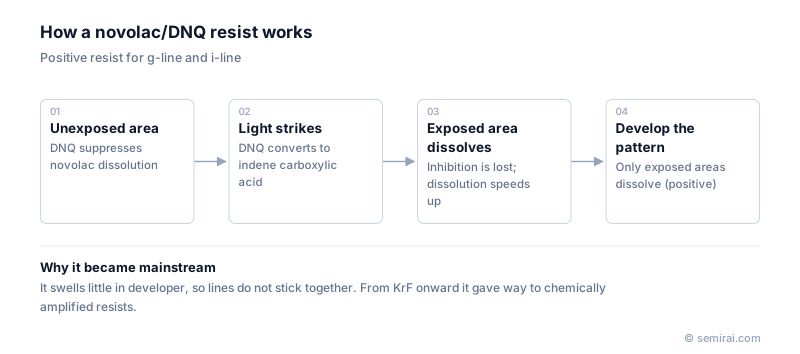
Novolac in g-line and i-line resists
Novolac dissolves in aqueous alkali, but mixing in the photosensitive compound diazonaphthoquinone (DNQ) strongly slows that dissolution. Light converts DNQ into an indene carboxylic acid that dissolves readily in alkali, so only the exposed areas wash away in TMAH developer, giving a positive pattern.
Novolac/DNQ resists swell little in developer and resist dry etching well, which made them the workhorse of g-line and i-line lithography from the 1980s. Both components absorb strongly at the 248 nm KrF wavelength, so light cannot reach the bottom of the film. From KrF onward they were replaced by chemically amplified resists based on polyhydroxystyrene (PHS) and other transparent polymers. Novolac resists remain in use for i-line layers, thick-film resists and packaging processes.
Novolac in package mold compounds
Epoxy mold compounds that encapsulate chips rely on novolac chemistry. Phenol novolac resin acts as the hardener for epoxy resin, producing an encapsulant with good heat resistance, moisture resistance and electrical insulation. Cresol novolac epoxy, in which epoxy groups are attached to the novolac backbone, has also been widely used as the base resin.
Japanese companies involved
- Tokyo Ohka Kogyo (TOK) supplies novolac-based positive resists for g-line and i-line lithography.
- Sumitomo Bakelite and Resonac make epoxy mold compounds in which phenolic novolac resins serve as hardeners or base resins.
- Tokyo Ohka Kogyo (TOK) · Photoresists and high-purity process chemicals
- Sumitomo Bakelite · Epoxy mold compounds and package materials
- Resonac · CMP slurries, packaging materials and SiC epitaxial wafers
- JSR · Photoresists and semiconductor materials
FAQ
What is the difference between novolac and resol?
Both are phenol-formaldehyde resins. Novolac is made with an acid catalyst and an excess of phenol, so it is thermoplastic and needs a hardener to cure. Resol is made with an alkaline catalyst and an excess of formaldehyde, leaving reactive groups that let it cure by heating alone.
Why are novolac resists not used for KrF exposure?
Novolac and DNQ absorb too much light at 248 nm, so the dose is used up near the top of the film and the pattern bottom is underexposed, giving sloped profiles. KrF resists use polymers that are transparent at that wavelength together with acid catalysis to restore sensitivity.
Related pages
Sources
Last updated: November 1, 2026