Swelling
Swelling is the increase in volume of a polymer, such as a resin, when it absorbs a solvent or water without dissolving. Liquid molecules enter the spaces between polymer chains; cross-linked networks cannot dissolve, so they swell instead. In lithography, swelling during development once limited how fine resist patterns could be.
Also called: polymer swelling, resist swelling
Diagram
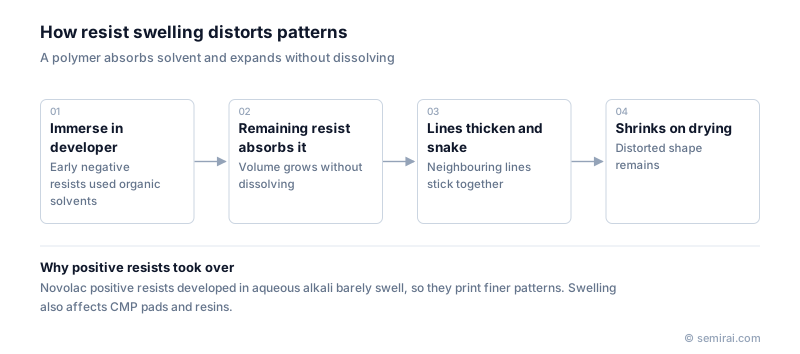
Swelling in photoresist development
Early negative resists based on cyclised rubber were developed in organic solvents. The exposed areas were cross-linked and did not dissolve, but they absorbed the solvent developer and swelled. Swollen lines touched their neighbours or snaked sideways, and after drying the distorted shape remained, so fine patterns could not be made.
Positive resists based on novolac resin are developed in aqueous alkali (TMAH) and hardly swell. That higher resolution is one reason they became the mainstream from the 1980s as feature sizes shrank. Modern negative resists also suppress swelling through the choice of developer and resin design.
Swelling elsewhere in the fab
CMP polishing pads absorb water and slurry and swell, changing their hardness and shape, so pad break-in and storage conditions are controlled. In resist stripping, swelling is used on purpose: the stripper swells the resist first so that it comes off efficiently.
Porous low-k dielectrics and package resins can absorb moisture. The resulting swelling raises the dielectric constant, changes stress and can cause delamination, so moisture barriers and drying steps are built into the process.
Japanese companies involved
- Tokyo Ohka Kogyo (TOK) and JSR develop photoresists whose resin and developer combinations are designed to keep swelling low.
- Tokyo Ohka Kogyo (TOK) · Photoresists and high-purity process chemicals
- JSR · Photoresists and semiconductor materials
FAQ
Why do cross-linked polymers swell instead of dissolving?
Cross-links tie the chains into a single network, so solvent molecules can push the chains apart but cannot carry them away into solution. The network stretches until the elastic force of the chains balances the solvent's tendency to enter. A higher cross-link density therefore means less swelling.
Why did swelling make positive resists win?
Fine lines in solvent-developed negative resist swelled, bent and stuck together, which capped resolution. Novolac positive resists developed in aqueous alkali dissolve cleanly in the exposed areas while the unexposed areas barely take up liquid, so they could print much finer features with straight edges.
Related pages
Sources
Lithography terms
- All lithography terms
- TMAH (Tetramethylammonium Hydroxide)
- EUV vs DUV lithography: what is the difference?
- High-NA EUV vs standard EUV: what is the difference?
- Single patterning vs multi-patterning: what is the difference?
- Chemically amplified resist vs metal oxide resist: what is the difference?
- Bottom Anti-Reflective Coating (BARC)
- Chemically Amplified Resist (CAR)
Last updated: November 2, 2026