TMAH (Tetramethylammonium Hydroxide)
TMAH (tetramethylammonium hydroxide) is a strongly alkaline organic compound, (CH₃)₄NOH, and the most widely used developer for photoresists. Unlike sodium or potassium hydroxide it contains no metal ions, so it does not contaminate transistors, which is why it became the semiconductor standard.
Also called: tetramethylammonium hydroxide, TMAH developer
Diagram
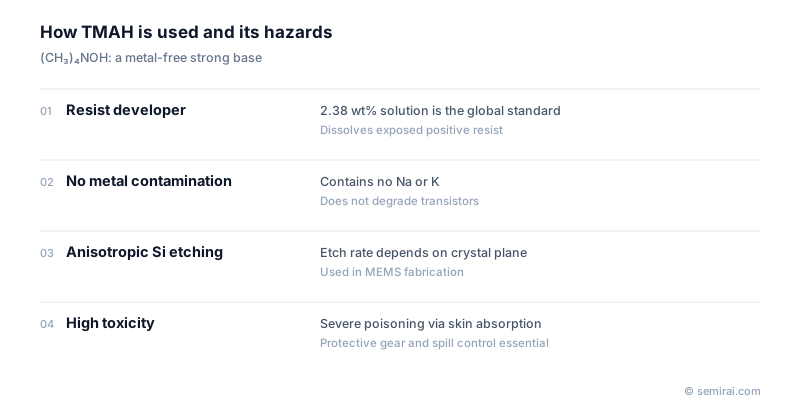
TMAH as a resist developer
During development, TMAH dissolves the parts of the resist that exposure has made soluble in alkali, revealing the pattern. An aqueous solution of 2.38 wt% (0.26 N) is the worldwide standard, and most resists are formulated to perform best at that concentration. Inside a coater/developer the solution is puddled on the wafer or sprayed while it spins, then rinsed off with ultrapure water.
Small changes in development time, temperature or concentration shift the printed linewidth, so high-purity developer with tightly controlled concentration is used. Insufficient development leaves resist residue, called scum, at the bottom of the pattern.
Silicon etching and safety
More concentrated TMAH solutions etch silicon anisotropically: they attack the {100} planes quickly and the {111} planes very slowly, producing V-grooves and sloped cavities. This is used in MEMS fabrication. Because TMAH is metal-free, it fits with CMOS processing more easily than potassium hydroxide, the other common anisotropic etchant.
TMAH is highly toxic. It is absorbed through the skin and interferes with nerve and respiratory function, and fatal accidents involving skin contact have been reported in several countries. Workers wear protective equipment, exposed skin is washed immediately with large amounts of water, and spent developer is collected for recovery or treatment.
Japanese companies involved
- Tokuyama produces high-purity TMAH-based developer for positive photoresists.
- Tokyo Ohka Kogyo (TOK) supplies photoresists together with the process chemicals, including developers, used with them.
- Tokuyama · Polysilicon and electronic chemicals
- Tokyo Ohka Kogyo (TOK) · Photoresists and high-purity process chemicals
- Kanto Chemical · High-purity process chemicals for cleaning, etching and CMP
FAQ
Why is the developer concentration 2.38%?
It became the industry standard concentration, and resist makers now design their products to give the best resolution and sensitivity at 2.38 wt% (0.26 N). The shared standard lets fabs use one developer for resists from different suppliers, which simplifies chemical supply and tool setup.
Why is TMAH so dangerous?
The tetramethylammonium ion passes easily through skin and blocks nerve signalling, which can stop breathing. A splash of concentrated solution over a large area of skin can be fatal even if the burn itself looks minor. Protective gloves, face shields and immediate flushing with water are therefore mandatory.
Related pages
Sources
Lithography terms
- All lithography terms
- EUV vs DUV lithography: what is the difference?
- High-NA EUV vs standard EUV: what is the difference?
- Single patterning vs multi-patterning: what is the difference?
- Chemically amplified resist vs metal oxide resist: what is the difference?
- Bottom Anti-Reflective Coating (BARC)
- Chemically Amplified Resist (CAR)
- Coater/developer
Last updated: November 1, 2026