Ramp Rate
Ramp rate is the speed at which the temperature is raised (ramp-up) or lowered (ramp-down) in a thermal process, expressed in degrees per second or per minute. Together with the peak temperature and the hold (soak) time, it defines the temperature profile of an anneal, oxidation or diffusion step.
Also called: heating rate, cooling rate, ramp-up / ramp-down rate
Diagram
Typical rates by equipment
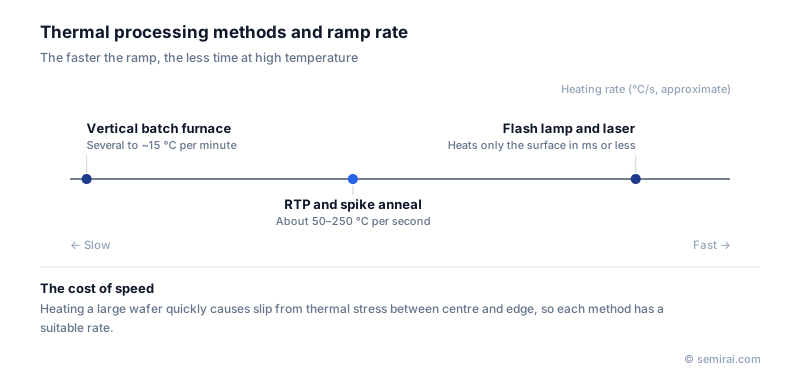
Vertical batch furnaces that process many wafers at once ramp slowly, roughly several to about fifteen degrees per minute. The wafer load has a large heat capacity, and heating a large wafer quickly creates a temperature difference between its centre and edge. The resulting thermal stress can make crystal planes slide, a defect called slip, which warps wafers and kills devices.
Rapid thermal processing (RTP), which heats one wafer at a time with lamps, ramps at roughly 50–250 °C per second. Flash lamp and laser anneals go further: they heat and cool only the surface layer within milliseconds or less, while the bulk of the wafer stays cooler.
Why faster ramps help
The main reason to ramp quickly is to shorten the time spent at high temperature, which reduces unwanted dopant diffusion and other heat-driven changes. In other words, it lowers the thermal budget. A spike anneal uses fast heating and fast cooling to reach the peak temperature needed for activation for only an instant.
Ramp rates are also specified in back-end processes. Solder reflow profiles and temperature cycling tests define them: too fast and parts crack or warp, too slow and throughput and joint quality suffer.
Japanese companies involved
- Kokusai Electric makes vertical batch furnaces whose ramp profiles are set to avoid slip in large wafer loads.
- SCREEN Holdings makes flash lamp annealing systems, which heat the wafer surface on millisecond time scales.
- Kokusai Electric · Batch deposition, diffusion and ALD equipment
- SCREEN Holdings · Wafer cleaning, coat/develop and inspection equipment
FAQ
Is the cooling rate as important as the heating rate?
Yes. Diffusion continues while the wafer is hot, so slow cooling adds thermal budget just like slow heating. Fast cooling can also freeze in a higher fraction of active dopants. However, cooling too fast creates the same thermal stress as fast heating.
How is wafer temperature measured during fast ramps?
Thermocouples respond too slowly, so RTP tools mainly use pyrometers that read the infrared light emitted by the wafer. Because emission depends on the films on the wafer, pyrometers must be calibrated or compensated for emissivity.
Related pages
Sources
Last updated: November 13, 2026