Thermal Budget
Thermal budget is the total amount of heat treatment a device can tolerate during manufacture, usually expressed as temperature integrated over time or as an equivalent time at a reference temperature. Every hot step adds to it, and because heat moves dopants and changes films, advanced chips must keep it as small as possible.
Also called: thermal history, heat budget
Diagram
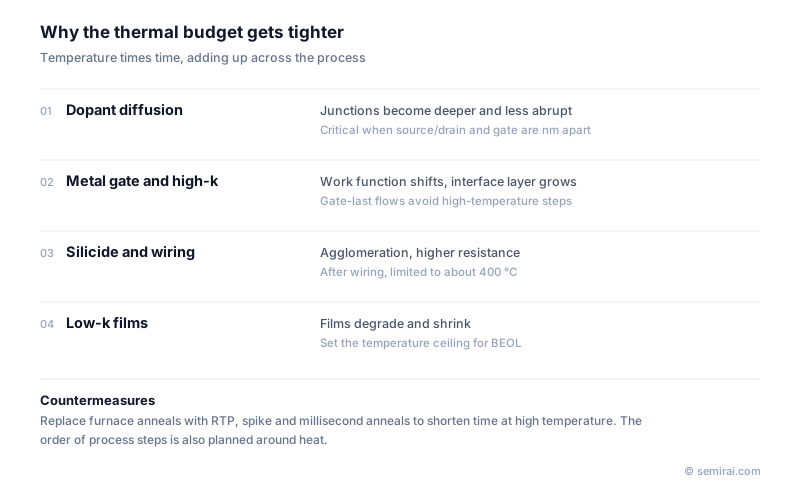
Why the budget keeps shrinking
Heat drives diffusion. In FinFET and gate-all-around (GAA) transistors the distance between source/drain and gate is only a few nanometres, so even a small extra spread of dopants changes the transistor. Metal gates and high-k dielectrics shift their work function and grow interface layers when heated too long, and silicides agglomerate and become more resistive.
After the interconnects are built, the limit drops to roughly 400 °C, because copper barriers and low-k dielectrics degrade above that. In 3D-stacked devices such as 3D NAND and HBM, new layers are built on top of finished devices, which must not be damaged by the heat used for the upper layers.
How fabs manage it
Process flows are arranged so that the hottest steps come first: gate oxidation and well formation early, low-temperature source/drain activation later, and low-temperature metallisation last. Gate-last schemes exist partly so that the metal gate never sees the source/drain activation anneal.
Long furnace anneals are replaced by rapid thermal processing (RTP), spike anneals and millisecond anneals using flash lamps or lasers, which heat only the wafer surface for a very short time. Microwave annealing is another low-temperature option. Engineers check the result by measuring dopant profiles with secondary ion mass spectrometry (SIMS) and predict it with process simulators that calculate diffusion from the temperature-time profile.
Japanese companies involved
- Kokusai Electric makes vertical batch furnaces used for oxidation, diffusion and annealing, where long, well-controlled heating at moderate temperature is still needed.
- SCREEN Holdings makes flash lamp annealing systems, which heat the wafer surface for milliseconds to activate dopants with very little diffusion.
- SCREEN Holdings · Wafer cleaning, coat/develop and inspection equipment
- Kokusai Electric · Batch deposition, diffusion and ALD equipment
FAQ
How is thermal budget calculated?
Because diffusion follows an Arrhenius law, a simple sum of temperature times time is only a rough guide. In practice engineers integrate the diffusivity over the whole temperature profile, which gives the Dt product that sets how far dopants move, or convert each step into an equivalent time at one reference temperature.
Why does a short spike anneal use less thermal budget than a furnace anneal at the same peak temperature?
Diffusion depends on how long the wafer stays near the peak. A furnace holds the wafer for minutes and heats and cools slowly, while a spike anneal reaches the peak and falls back within about a second, so far less diffusion happens for the same dopant activation.
Related pages
Sources
Last updated: November 2, 2026